The record of a boat's voyages, with times, positions, courses, weather and events, written as they happen.
A logbook is the running record of a boat's voyages. Entry by entry it notes what happened on board and when: departure and arrival, position, course and speed, wind and weather, sail changes and manoeuvres, engine hours and anything unusual. The name comes from the log, the device that measured the ship's speed, and whose readings were written into the book.
What goes in
A typical entry, every hour or at every significant event, records:
- Time and position, plus course and speed or the log reading.
- Wind (direction and strength on the Beaufort scale) and weather: cloud cover, visibility, barometer, sea state.
- Events. Tacks and gybes, reefs, engine on and off, anchoring, incidents.
Why keep one
- Navigation. With regular positions, you can always fall back on dead reckoning.
- Evidence. After an incident, a logbook shows what happened. Commercial vessels must keep one; for leisure sailors it's good seamanship.
- Sea miles. Many licences and charter companies ask for documented miles, and a logbook is the usual proof.
- Memory. Years later, it's the story of where you've been.
Manta keeps the logbook automatically: it notices departure, tacks, gybes, anchoring and engine on and off, and writes them in, while your own entries take one or two taps. More in the guide how to keep a logbook.
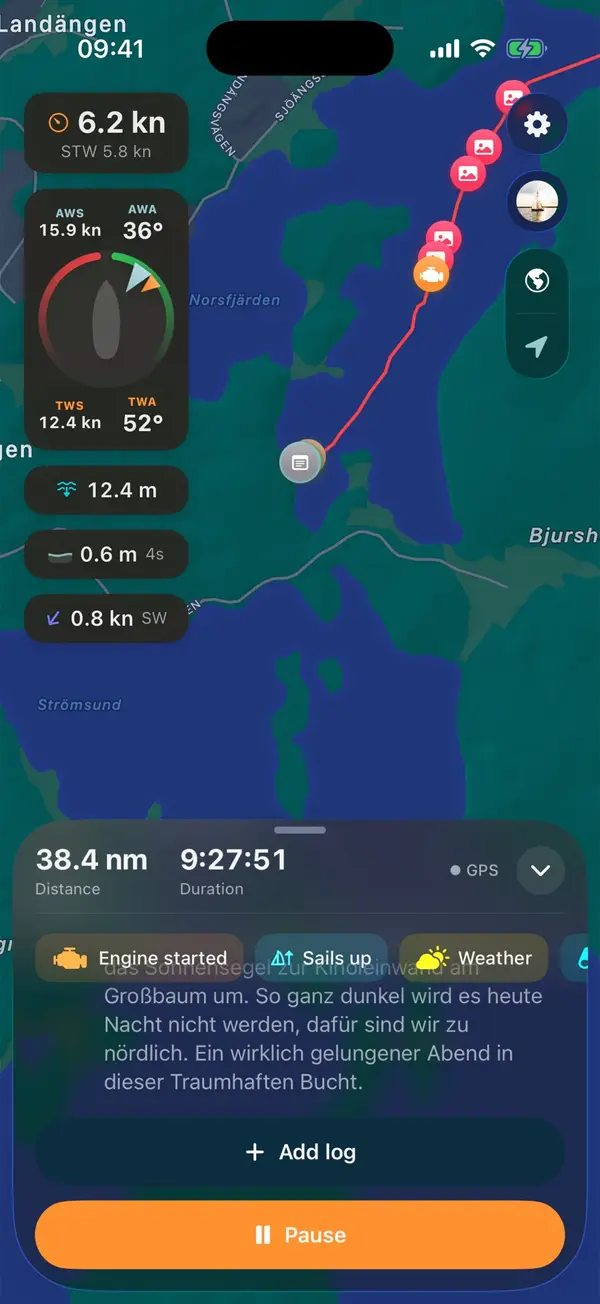
Manta does this for you
Automatic sailing logbook
A digital logbook that fills itself. Manta notices when you cast off, tack, gybe, drop anchor or moor, and writes it into your log by itself. Every automatic entry stays editable.