The scale from 0 to 12 that describes wind strength by its effects, from calm to hurricane force.
The Beaufort scale describes wind strength in 13 steps, from force 0 (calm) to force 12 (hurricane). It was devised in 1805 by the British naval officer Francis Beaufort, originally by what a sailing warship could carry, and later linked to measured wind speeds. Marine forecasts and many logbooks still give wind in Beaufort.
The scale
| Force | Description | Knots |
|---|---|---|
| 0 | Calm | < 1 |
| 1 | Light air | 1–3 |
| 2 | Light breeze | 4–6 |
| 3 | Gentle breeze | 7–10 |
| 4 | Moderate breeze | 11–16 |
| 5 | Fresh breeze | 17–21 |
| 6 | Strong breeze | 22–27 |
| 7 | Near gale | 28–33 |
| 8 | Gale | 34–40 |
| 9 | Strong gale | 41–47 |
| 10 | Storm | 48–55 |
| 11 | Violent storm | 56–63 |
| 12 | Hurricane force | ≥ 64 |
Good to know
- The values are averages over ten minutes at 10 m height. Gusts can be one or two forces stronger and are forecast separately.
- The apparent wind on board is not the Beaufort force: upwind it reads higher, downwind lower. Use the true wind.
- From force 6 onward, many coastal forecasts issue strong-wind warnings.
More in the guide to the Beaufort scale.
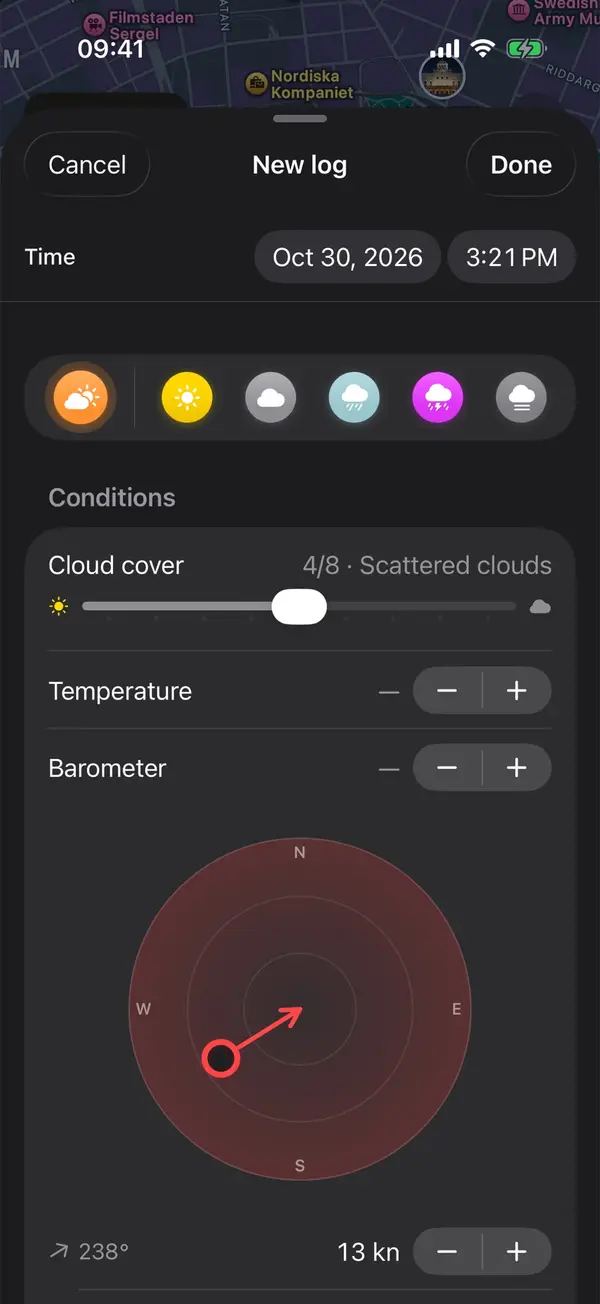
Manta does this for you
Weather log for every sailing trip
Every trip shows wind, sea state and weather for each hour. Where your instruments are silent, Apple Weather fills the gaps.