The scale from 0 to 9 that describes the state of the sea by wave height, from glassy calm to phenomenal.
The Douglas sea scale describes the state of the sea in ten steps, from 0 (calm, glassy) to 9 (phenomenal). It is named after Henry Percy Douglas, a Royal Navy officer who devised it in the early 20th century. Each step stands for a range of wave heights, strictly the significant wave height of the wind sea.
The scale
| Degree | Description | Wave height |
|---|---|---|
| 0 | Calm (glassy) | 0 m |
| 1 | Calm (rippled) | 0–0.1 m |
| 2 | Smooth | 0.1–0.5 m |
| 3 | Slight | 0.5–1.25 m |
| 4 | Moderate | 1.25–2.5 m |
| 5 | Rough | 2.5–4 m |
| 6 | Very rough | 4–6 m |
| 7 | High | 6–9 m |
| 8 | Very high | 9–14 m |
| 9 | Phenomenal | over 14 m |
Wind sea and swell
The original scale has a second part for swell (waves that have travelled away from the wind that made them), graded by length and height. In everyday use, "sea state 4" usually means the wind sea alone.
Sea state and wind
Wind and sea state are related but not the same: a sea needs time and open water (fetch) to build, and it takes a while to calm down after the wind drops. Against a current, waves get shorter and steeper. More in the guide sea state and waves.
Manta does this for you
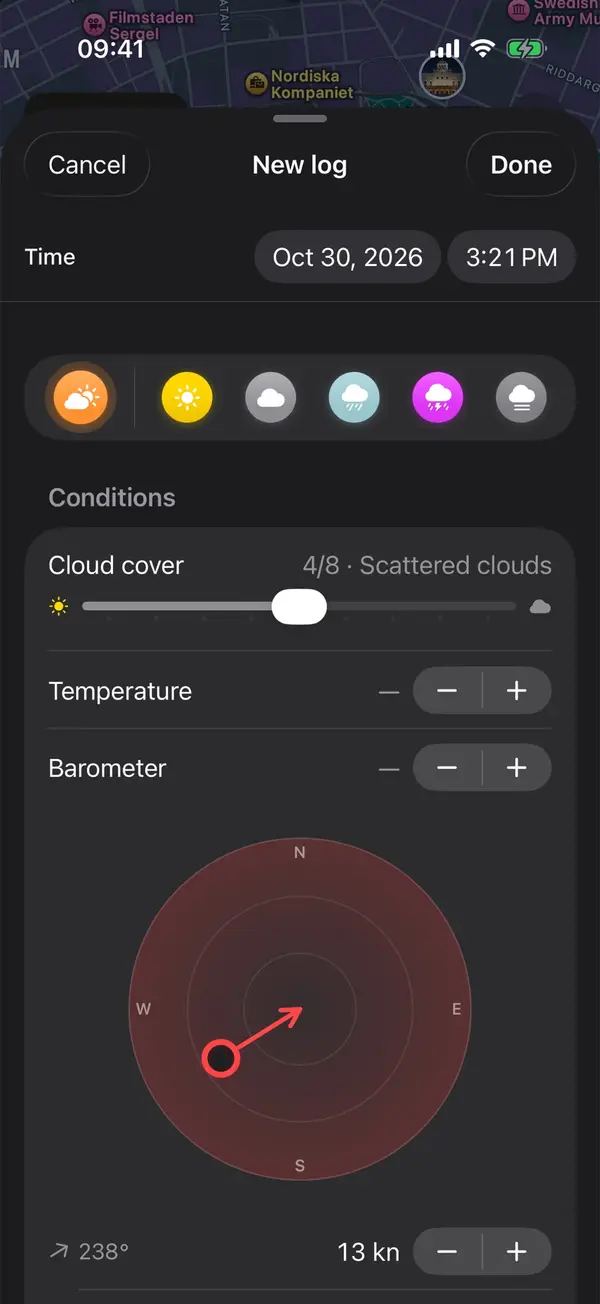
Weather log for every sailing trip
Every trip shows wind, sea state and weather for each hour. Where your instruments are silent, Apple Weather fills the gaps.