Significant wave height, wave period, wind sea and swell, and the Douglas sea scale. How to read a wave forecast and what it means on a sailing boat.
Photo: Tim Marshall, Unsplash
Sea state describes how rough the sea is. Forecasts give it as significant wave height (about the average height of the highest third of the waves) together with the wave period, the time between two crests. Height tells you how big the waves are; period tells you how steep and uncomfortable they will be. The Douglas sea scale turns wave height into a number from 0 (calm) to 9 (phenomenal).
Significant wave height
Waves are never all the same size. Significant wave height (Hs) is the average of the highest third. It matches quite well what an experienced sailor would estimate by eye.
- Most waves are lower than Hs.
- Now and then a single wave reaches up to about twice Hs. Over a long passage, expect to meet some.
Wave period
The period is the time between two crests passing the same point, in seconds. With the same height:
| Period | Feels like |
|---|---|
| Short (under about 6 s) | Steep, choppy, the boat pounds and slows |
| Medium (about 6–10 s) | Typical for a building wind sea |
| Long (over about 10 s) | Long, rolling waves, usually swell from far away |
A short period with a large height is the uncomfortable combination. In shallow water and near the coast, waves also get steeper.
Wind sea and swell
- Wind sea is made by the wind blowing where you are. It grows with wind strength, the time it blows and the distance over open water (the fetch).
- Swell is made by wind somewhere else and travels far. It has a longer period and can roll in on a calm day.
When wind sea and swell come from different directions, the sea gets confused: hard to steer and tiring for the crew. Good forecasts give both separately.
The Douglas sea scale
| Code | Description | Wave height |
|---|---|---|
| 0 | Calm (glassy) | 0 m |
| 1 | Calm (rippled) | 0–0.1 m |
| 2 | Smooth | 0.1–0.5 m |
| 3 | Slight | 0.5–1.25 m |
| 4 | Moderate | 1.25–2.5 m |
| 5 | Rough | 2.5–4 m |
| 6 | Very rough | 4–6 m |
| 7 | High | 6–9 m |
| 8 | Very high | 9–14 m |
| 9 | Phenomenal | over 14 m |
These are the WMO sea state codes, and the words are those used in many marine forecasts. A short definition is in the glossary: Douglas sea scale. For how wind and waves go together, see The Beaufort scale.
What makes waves worse
- Wind against current or tide: shorter, steeper, breaking waves.
- Shallow water: waves slow down, steepen and can break.
- Headlands and harbour entrances: waves bunch up and reflect.
- A rising wind: a young sea is short and steep before it lengthens.
Sea state in your log
Manta shows wind, sea state and weather for every hour of a trip. The waves are estimated from the boat's own motion, so they are the waves you actually sailed through. The wave chart is part of Manta Pro.
Questions
What does a wave height of 2 metres in the forecast mean?
It is the significant wave height, roughly the average of the highest third of the waves. Many waves will be lower, and now and then a single wave can be close to twice as high.
Is a long or a short wave period better?
For the same height, a longer period is usually more comfortable. The waves are longer and less steep. Short-period waves of the same height are steep and make a boat pound.
Why are waves worse when wind blows against the current?
The current shortens the waves while the wind keeps building them, so they get steeper and break more easily. Tidal races and harbour entrances on the ebb are classic places for this.
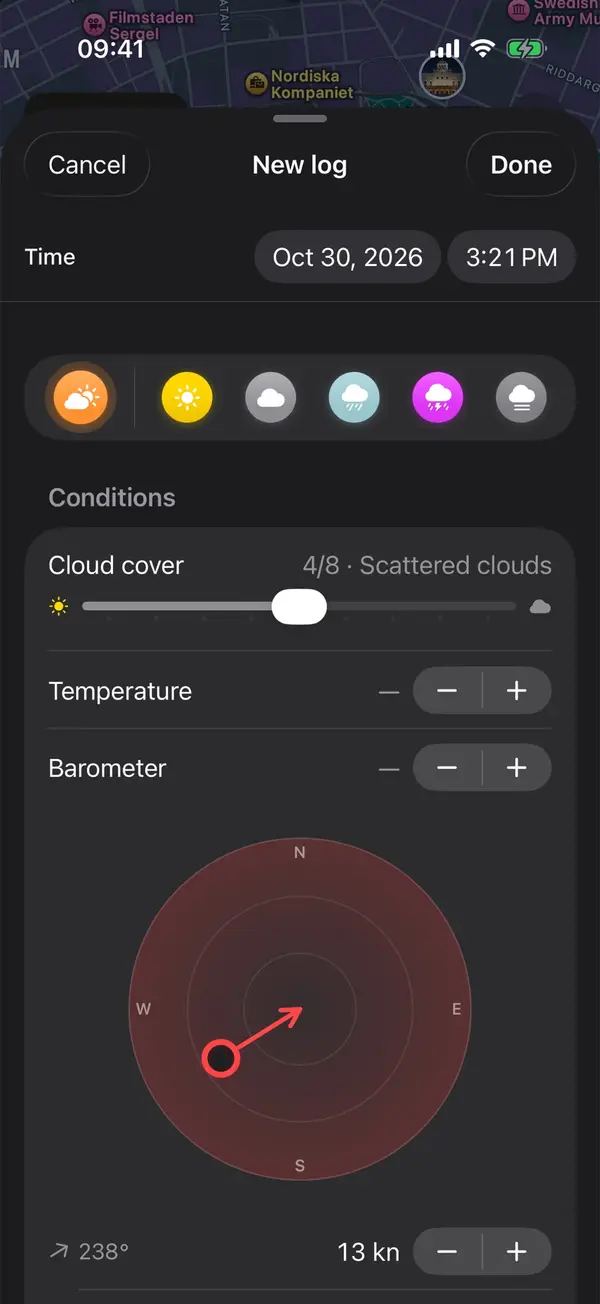
Manta does this for you
Weather log for every sailing trip
Every trip shows wind, sea state and weather for each hour. Where your instruments are silent, Apple Weather fills the gaps.