A polar diagram shows how fast a sailboat should go at every wind angle and wind speed. How to read one, find your best upwind and downwind angles, and use it on board.
Photo: Karla Car, Unsplash
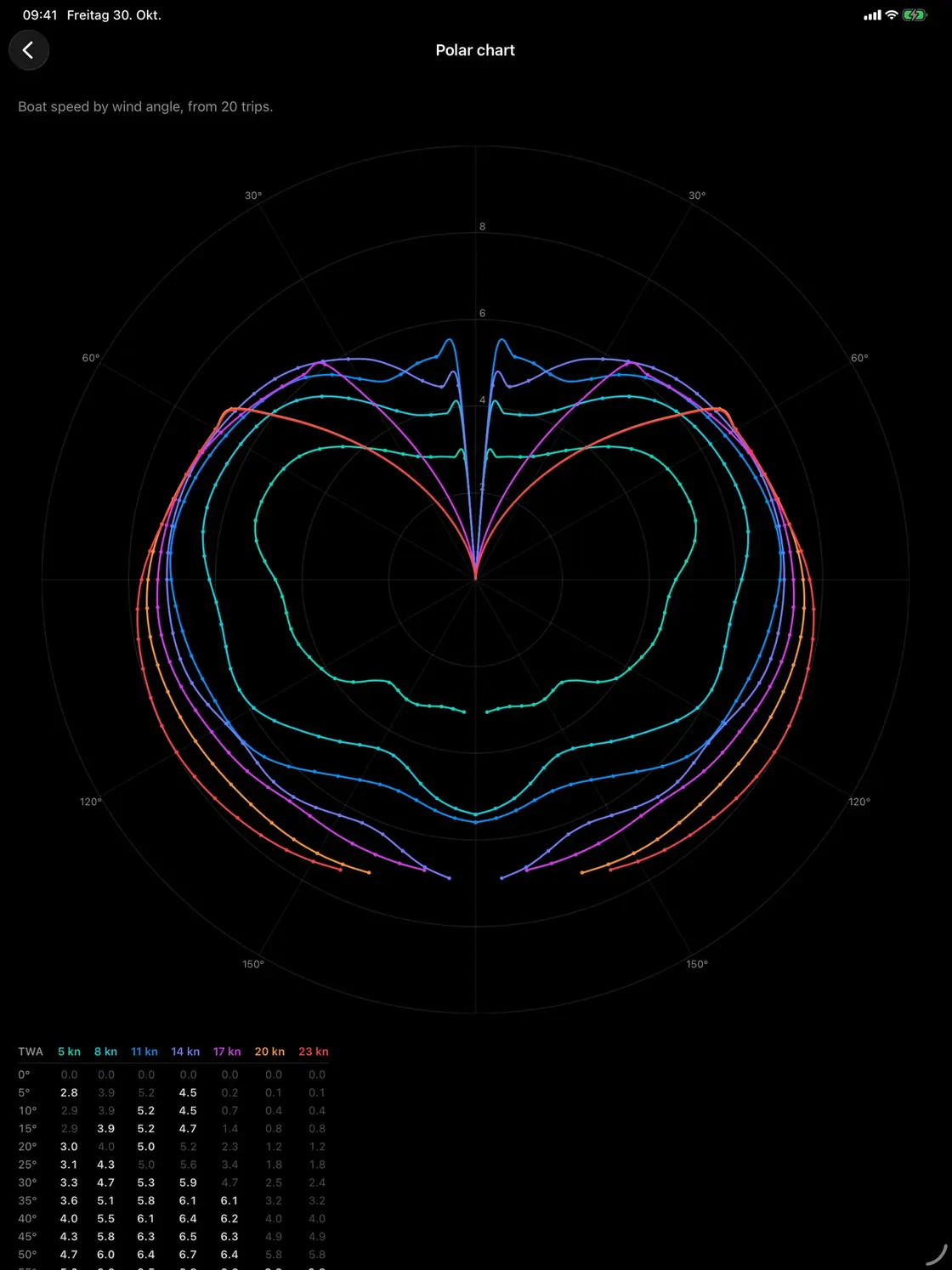
A polar diagram shows a boat's expected speed at every angle to the true wind, with one curve per wind speed. Read it like a clock face with the wind coming from the top: the further a curve reaches from the centre at a given angle, the faster the boat sails there. From it you can find the best angle to sail upwind and downwind, and the target speed for any wind.
The parts of a polar diagram
- The centre: the boat.
- The angle around it: the true wind angle (TWA), 0° at the top (straight into the wind) to 180° at the bottom (dead downwind).
- The distance from the centre: boat speed in knots, marked by circles.
- Each curve: one true wind speed (TWS), for example 6, 10, 14 and 20 knots.
Because a boat sails the same on both tacks, most polars show only one half.

Reading a polar diagram
- Pick the curve for the current true wind speed.
- Follow your true wind angle out from the centre until it meets the curve.
- Read the boat speed from the circles at that point.
Example: on the 12-knot curve at 90°, the curve might meet the 7-knot circle. That's the target speed on a beam reach in 12 knots of wind.
Best angles upwind and downwind
Sailing closer to the wind shortens the distance but slows the boat. The best compromise is the angle with the highest VMG (velocity made good towards or away from the wind).
- Upwind: draw a horizontal line that just touches the top of the curve. The touching point is the best upwind angle and speed.
- Downwind: do the same at the bottom of the curve. For many boats the best downwind angle is not dead downwind but somewhere around 140–160°, so gybing downwind can be faster.
These best angles change with wind speed, which is why each curve has its own.
Using polars on board
- Target speeds: if you're well below the polar, check trim, sail choice and course.
- Routing: weather-routing software uses polars to calculate the fastest route.
- Planning: a realistic polar tells you how long a passage will take on each point of sail.
Use true wind, not apparent wind, when reading a polar. See True vs apparent wind. The basics of the angles are in Points of sail.
Polars from your own trips
Published polars are ideal values. Manta Pro builds your boat's polar diagram from the trips you sail and shows how well she performs on every point of sail. The glossary has a short definition of the polar diagram.
Questions
Where do I get my boat's polar diagram?
Designers and builders often publish polars calculated with a velocity prediction program (VPP). Rating systems such as ORC publish them for measured boats. Or you build your own from recorded sailing data.
Why is my boat slower than its polar?
Published polars assume a clean hull, good sails, flat water and expert trim. A loaded cruising boat in waves usually sails below them, which is why polars built from your own trips are more useful for planning.
Why does the polar only show one side?
A boat sails the same on port and starboard tack, so the diagram is symmetrical. Showing one half saves space.
Manta does this for you
Sailing polar diagrams from your own trips Pro
Manta builds your boat's polar diagram from the trips you sail and shows how well she performs on every point of sail.