True wind is the wind you'd feel standing still; apparent wind is what you feel on a moving boat. Why they differ, how to work one out from the other, and which to use when.

True wind is the wind as it blows across the water, what you'd feel on an anchored boat. Apparent wind is what you feel on a moving boat: the true wind combined with the headwind your own speed creates. Your sails, the masthead vane and the wind instrument all see apparent wind; forecasts, the Beaufort scale and your logbook use true wind.
Why they differ
Cycle on a calm day and you feel a breeze in your face. That's the wind your own motion makes. On a boat, this headwind adds to the true wind. The result, the apparent wind, is:
- Further forward than the true wind on every point of sail except a dead run.
- Stronger than the true wind when sailing upwind.
- Weaker than the true wind when sailing downwind.

Three examples
All with a boat speed of 6 knots:
| Point of sail | True wind | Apparent wind |
|---|---|---|
| Close-hauled | 12 kn at 45° | about 17 kn at 30° |
| Beam reach | 10 kn at 90° | about 12 kn at 59° |
| Running | 15 kn at 180° | 9 kn at 180° |
This is why a beat feels so much windier than the run back home, and why it's easy to carry too much sail downwind. Reef for the true wind, not for how it feels on the run.
Working one out from the other
Apparent wind is the vector sum of the true wind and the headwind from the boat's motion. Instrument systems do this for you: from apparent wind angle and speed, boat speed and heading, they calculate true wind angle (TWA), true wind speed (TWS) and true wind direction (TWD).
Strictly, instruments use speed through the water, so their "true" wind is relative to the water. In a current, that differs from the wind over the ground that the forecast gives.
Which wind for what
| Task | Use |
|---|---|
| Trimming sails, telltales | Apparent wind |
| Comparing with the forecast | True wind |
| Deciding when to reef | True wind |
| Logbook entries | True wind |
| Polar diagrams and VMG | True wind |
Wind data in your log
With your plotter or a WiFi gateway connected, every log entry carries real wind from your instruments, alongside depth and speed through the water. The glossary has short definitions of true wind and apparent wind.
Questions
Which wind does the forecast give?
True wind, strictly wind over the ground. Your wind instrument measures apparent wind, and the instrument system calculates true wind from it using your boat speed and heading.
Which wind do I trim my sails to?
Apparent wind. It is the wind the sails actually meet, which is why telltales and the masthead wind vane show apparent wind.
Why does it feel so calm when sailing downwind?
Because your own speed is subtracted from the true wind. With 15 knots of wind from astern and 6 knots of boat speed, you feel only 9 knots, until you turn upwind.
What are TWS, TWA, AWS and AWA?
True wind speed, true wind angle, apparent wind speed and apparent wind angle. The angles are measured from the bow, the speeds in knots.
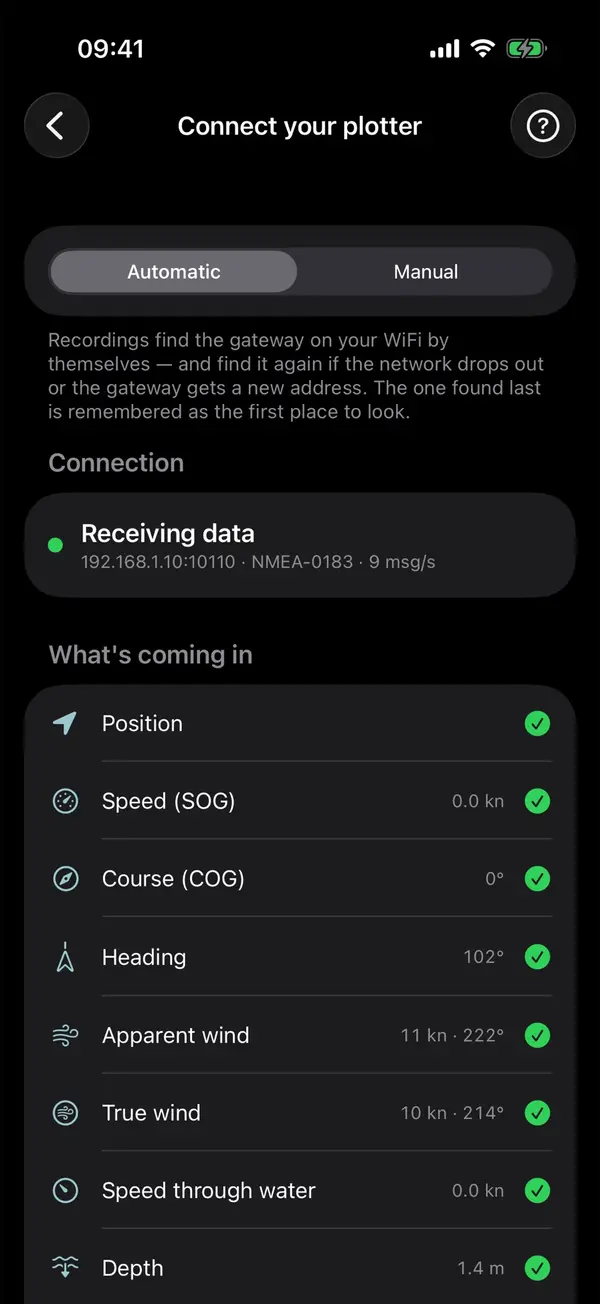
Manta does this for you
Plotter data on your iPhone over WiFi
Connect your plotter or a WiFi gateway, and Manta shows your instruments live and records wind, depth and speed through the water on every trip.