How often to service a sailboat engine: a marine diesel service interval table from the manuals, first service, low-load running, lay-up and a yearly plan.
Photo: Isabela Kronemberger, Unsplash
How often to service a sailboat engine comes down to two limits: the manual's hours figure and its calendar figure, whichever arrives first. A typical cruising yacht runs its engine something like 50 to 100 hours a year (that's a rule of thumb from experience, and it varies), so the yearly limit usually comes first and a marine diesel service happens once a year. The table below shows what three engine manuals actually state. Your own manual comes first.
How often to service a sailboat engine: intervals from the manuals
These are taken from the Volvo Penta D2-55 operator's manual, the Yanmar YM series operation manual (2YM15, 3YM20, 3YM30) and the Beta 14 manual. Check the manual for your exact model, since intervals vary between engines from the same maker.
| Item | Volvo Penta D2 | Yanmar YM series | Beta 14 |
|---|---|---|---|
| Engine oil | 500 h or yearly | 150 h or yearly | 250 h or yearly |
| Oil filter | 500 h or yearly | 250 h or yearly | 250 h or yearly |
| Fuel filter | 500 h or yearly | 250 h or yearly | 750 h |
| Water separator or pre-filter | Drain every 14 days, replace 500 h or yearly | Drain every 100 h or six months | Drain daily |
| Sea water impeller | Check 500 h or yearly | Check 250 h or yearly, replace 1000 h or 4 years | Check 250 h or yearly, replace if worn |
| Drive belt | Check every 14 days | Adjust 250 h or yearly, replace 1000 h or 4 years | Check tension daily, inspect 750 h |
| Coolant | 500 h or two years | Yearly, or two years with long life coolant | Antifreeze 750 h |
| Sacrificial anodes | Replace at 50 percent lost, check 200 h or yearly | See manual | Check 250 h or yearly, possibly six months or less |
| Gearbox oil | 200 h or yearly | 250 h or yearly | 750 h |
| Saildrive oil | 200 h or yearly | 100 h or six months | See gearbox manual |
| Saildrive seal or diaphragm | Rubber seal every seventh year | See manual | See manual |
| Valve clearance | 500 h or two years, workshop | Adjust after first 50 h, then 1000 h or 4 years with dealer | See manual |
| Exhaust elbow | See manual | Clean or replace 250 h or yearly | See manual |
| Hoses | See manual | See manual | Inspect 750 h, replace as needed |
If your boat has a shaft and not a saildrive, the Volvo manual also has a shaft seal item, replaced every 500 hours or fifth year.
Why the calendar limit usually comes first
Oil ages even in a resting engine, and moisture and acids build up during short runs. Impellers take a set, coolant inhibitors decay, and anodes waste away whether the engine runs or not. If you motor 80 hours a season, a 500-hour limit would take six years to reach, and every manual here also sets a calendar limit so that doesn't happen. Volvo Penta states it plainly: when both operating time and calendar time are given, the first to arrive applies.
First service of a new engine
The first service matters more than people assume. Volvo Penta says oil and oil filters must be changed after 20 to 50 hours on a new or reconditioned engine, and requires a first service inspection at an authorised workshop. Yanmar's schedule lists an initial 50-hour service including oil, oil filter, gear oil and belt and valve checks, and Beta's schedule has jobs after 25 hours and after 50. Put the first service in the log the day the engine is launched.
Low-load running and idling while charging
A diesel likes work. Yanmar's manual advises operating the engine at near maximum speed from time to time while underway, which generates higher exhaust temperatures and helps burn off hard carbon deposits. Long spells of idling at anchor do the opposite. The manual also describes a cool-down at low speed, without load, before shutting down.
If you use the engine to charge the batteries at anchor, plan for some loaded running as well, and look at solar or a generator for the rest. Volvo Penta adds that if the boat is left in the water and unused, the engine must be brought to operating temperature at least once every 14 days.
What you can do yourself
| Usually fine for a careful owner | Leave to a yard or dealer |
|---|---|
| Oil and filter change | Warranty first service inspection |
| Fuel filter change and bleeding | Injector testing |
| Impeller check and replacement | Valve clearance, on most engines |
| Belt tension | Shaft alignment |
| Anode replacement | Saildrive seal or diaphragm replacement |
| Cleaning strainer | Fuel timing |
Warranty conditions vary, so read the warranty book before you do anything. Volvo Penta marks some items for an authorised workshop and requires the first service inspection there. Yanmar warns that failing to perform periodic maintenance may void the warranty, and that alterations to the engine may void it too. Keep every receipt and write each job in the log.
Winter lay-up
Volvo Penta says to inhibit the engine if the boat won't be used for more than two months. Its lay-up list includes changing the drive oil, cleaning and inhibiting the seawater system, removing the impeller and storing it in a sealed bag somewhere cool, and filling the fuel tank to avoid condensation. It also warns that anti-corrosion coolant gives no protection against freezing, so if freezing is possible the system must be drained or protected. Yanmar likewise says to drain the seawater system if there is a risk of freezing.
For the UK, northern Europe, Canada or the northern US, this is an autumn job. In Florida, the Caribbean or the warmer parts of Australia and New Zealand, boats may have no true lay-up, so the yearly service is simply a fixed date, and the risk is corrosion and long inactivity. Hurricane-season storage calls for its own preparation.
Outboards in brief
Outboards run on their own schedules. Many ask for an annual gear oil change and an impeller at a stated interval, and a flush after salt water, but this differs by model and between two-stroke and four-stroke. Read the outboard's manual and keep its hours separately from the main engine.
A year's plan by month
This is a sample plan for northern hemisphere sailors with a winter lay-up. In the southern hemisphere, shift it by six months. In warm climates without a lay-up, keep the same order and tie it to your quietest month.
| Month | Work |
|---|---|
| October | Haul out, change oil and filter while warm, flush and inhibit, drain or protect from frost |
| November | Remove impeller, record engine hours, list parts needed |
| January, February | Order parts, send injectors or heat exchanger for service if due |
| March | Fuel filters, belts, hoses and clips, exhaust elbow inspection, anodes |
| April | Refit impeller, launch checks, run up to temperature, check for leaks |
| July | Mid-season check of oil, coolant, strainer, belt |
Records for warranty and resale
Write down the date, engine meter reading, what you did, parts with numbers, who did it, and keep the receipts. A buyer who sees a clear oil and impeller record trusts the engine more, and a dealer handling a warranty claim will ask for the same facts. See logging engine hours for the routine, and the boat maintenance log for the format.
Engine service in Manta
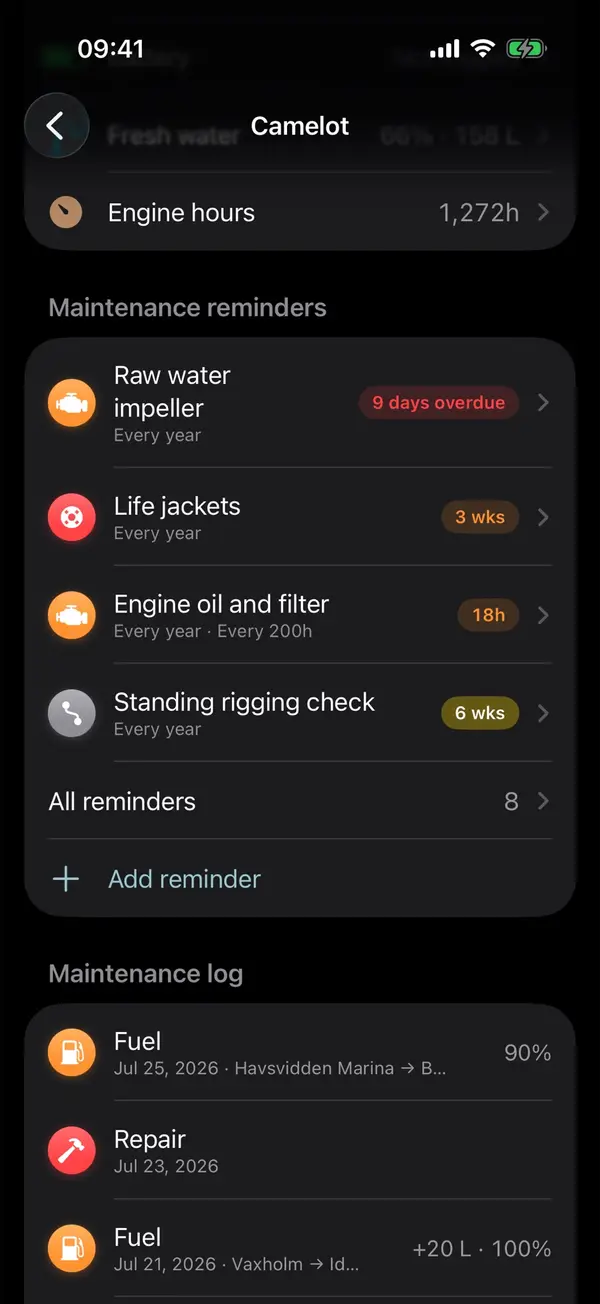
Manta's engine detection logs engine on and off from your instruments or from hull vibration together with speed and course, and the boat's engine hours count up from each run. You still read the real meter from time to time and correct it. Maintenance reminders (Pro) can be set per job by date, by engine hours, or both, whichever comes first. The setup template suggests starting values such as engine oil and filter yearly or 200 h, fuel filters yearly or 250 h, impeller yearly and coolant every two years, which you should change to match your manual.
Questions
How often should a sailboat engine be serviced?
At least once a year for most marine diesels, because the calendar limit arrives long before the hours on a typical cruising boat. Use the hours limit in your own manual as well, whichever comes first.
How often should I change the oil in a marine diesel?
Manuals differ. Volvo Penta's D2 lists every 500 hours or at least once a year, Yanmar's YM series lists every 150 hours or one year, and the Beta 14 lists every 250 hours or one year. Check yours.
Should I run my boat engine at anchor to charge the batteries?
Long idling at light load is hard on a diesel. Yanmar advises running near maximum speed from time to time under way to burn off carbon. If you charge at anchor often, plan for some loaded running as well.
Does servicing it myself affect the warranty?
It can. Volvo Penta requires an authorised workshop for the first service inspection and for the marked items in its schedule. Yanmar warns that skipping maintenance may void the warranty. Read your warranty book and keep receipts.
Manta does this for you
Maintenance reminders for your boat Pro
Get reminded when a job on your boat is due, by date, engine hours, sailing time or distance.