How to keep a boat maintenance log: what each entry needs, three sample entries, organising by system, rebuilding the history of a used boat and handing it on.
A boat maintenance log is the running record of everything done to the boat: what was serviced, repaired or replaced, when, at what engine hours, by whom and with which parts. Start one on the day you take over the boat, and every entry after that saves time when something breaks, when you sell, or when you need to explain a repair. Here is what each entry needs, how to organise them, and how to rebuild a history you never had.
Why a boat maintenance record pays off
Fault finding. Your engine overheats at anchor. Your log says the impeller was changed two seasons and 140 hours ago, the raw water strainer was last opened in June, and the heat exchanger has never been cleaned on your watch. You now know where to start.
Resale. A buyer who is shown dated oil changes, rigging inspections and receipts has fewer doubts, and a surveyor has less to guess at. Whether that raises the price is impossible to say, but it makes the conversation much easier.
Insurance. After a claim for a rig failure, the insurer may ask when the standing rigging was last inspected or replaced. A dated entry with the rigger's invoice is the answer. Check your policy for maintenance or survey conditions.
Warranty. Manufacturers can ask for proof of service. Yanmar's manual tells owners to log engine hours and to record repairs, parts and dates, and warns that not performing periodic maintenance may void the warranty. A log with receipts is what you hand over.
What each boat maintenance log entry needs
| Field | Why |
|---|---|
| Date | Calendar limits, and proof |
| Engine hours | Hour-based intervals |
| System | So you can find it later |
| What was done | Replaced, inspected, adjusted, cleaned |
| Parts and numbers | Reorder the right one in the right size |
| Who did it | Yourself or a named yard |
| Cost | Budget, and the trail for a sale or claim |
| Condition found | What the old part looked like |
| Next due | Date, hours or both |
| Photos | Before and after, and the part number |
Three sample entries
These are invented for illustration.
2026-04-11 | Engine hours 1402.5 | Engine: cooling
Replaced raw water impeller. Old impeller had two cracked vanes.
Part no. IMP-2210 (example), gasket replaced. Done by owner.
Cost 48.50. Next due: 2027-04 or 1602.5 h.
Photo: old impeller, inside of pump cover.

2026-05-02 | Rigging
Rig inspected by Solent Rigging (invoice 4471).
Lower port shroud terminal shows a hairline crack at swage.
Replace before next offshore passage. Rest of rig serviceable.
Next due: replace shroud by 2026-06-01. Full inspection 2027-05.

2026-06-14 | Engine hours 1484.9 | Engine: cooling
At anchor: temperature rising after motoring through weed.
Cleared raw water strainer, no other fault. Temperature normal.
Done by owner. No parts. No next due, note for trend.
The third entry looks trivial but tells you something useful next year, when the same symptom turns up and you can see it was weed the last time.
Organise by system
Keep one list in date order, and tag every entry with a system. Then "all the rigging work ever" is a filter and not a page-turning exercise.
| System | Typical entries |
|---|---|
| Engine and drive | Oil, filters, impeller, belts, anodes, shaft seal or saildrive |
| Fuel | Tank cleaning, filters, additives |
| Sails and rigging | Rigging checks, replacement, sail repairs, furler |
| Hull and deck | Antifouling, anodes, through-hulls, deck fittings, cleaning |
| Electrics | Batteries, charging, wiring changes, lights |
| Plumbing and gas | Gas hoses and regulator, heads, pumps, bilge pumps |
| Safety | Lifejackets, liferaft, flares, fire extinguishers |
| Survey and docs | Surveys, insurance, haul-out and launch records |
Number each piece of work if you want to link it to a spreadsheet or receipts. The reference format in our boat logbook template does that with M-006 style references.
What to keep from day one
Keep the engine manual, gearbox manual, wiring diagrams and rig dimensions in a folder. Photograph the fuses, batteries, seacocks and keel bolts while everything is working, since a picture of how it looked before you touched it is the most useful record you'll own. Keep invoices with the engine hours written on them. Make a list of every seacock, with its location and a date for the last time it was exercised.
Reconstructing the history of a used boat
Most used boats arrive with a carrier bag of paper or nothing at all.
- Ask the seller for invoices, service stamps, surveys, sail lofts and riggers they used.
- Contact the engine dealer with the engine serial number, and ask for its service history.
- Look in lockers and the back of the manual. Previous owners write dates in surprising places.
- Search the boat. Part stickers, dated hoses, stamped cylinders and battery date codes all tell you something.
- Work out what you can't prove, and treat those jobs as due now. An unknown impeller or rigging age should be taken as old.
- Write a starting entry that says "baseline inspection on takeover" with engine hours and photos. Everything afterwards counts from there.
Handing over to the next owner
When you sell, hand over the complete log, receipts and manuals. A printed or exported copy is fine, and a clear summary page helps: engine hours, last service, rigging age, sails, last antifouling and anything outstanding. If your record is in an app, check how you will pass it on before you need to. Remove anything private, such as insurance policy numbers or your home address.
Paper or app
| Paper or binder | Spreadsheet | App | |
|---|---|---|---|
| Lasts | As long as it stays dry | As long as you back it up | As long as the app and your backup do |
| Search | By page | Filter | Search, tags, per boat |
| Photos | Stuck in, or separate | Links | In each entry |
| Reminders | No | Basic formulas | Built in on some apps |
| Hand over | Physically | Send a file | Depends on export |
If you want your own columns, use the template with a maintenance sheet. If reminders are the main thing, read about choosing a boat maintenance app. For engine jobs the intervals are in how often to service a sailboat engine.
The maintenance log in Manta
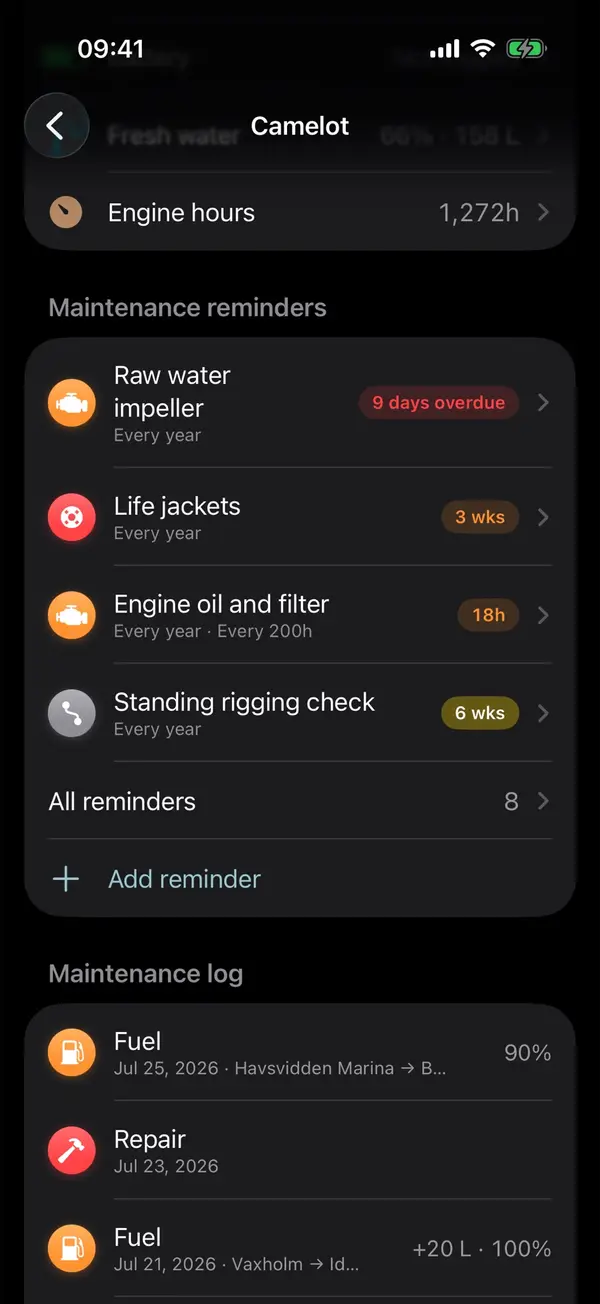
Manta keeps a maintenance log per boat, with entries for inspections, services, repairs, replacements, antifouling, cleaning, surveys, haul-out, launch, winterising, recommissioning, fuel and engine hours. Each entry can carry notes and photos, and you can log one during a trip as well. The whole logbook backup file includes maintenance, so a copy can go with the boat. Fuel and engine-hour logs are free, and saving any other work needs Manta Pro. Reminders for what comes next are Pro as well.
Questions
What should a boat maintenance log include?
Date, engine hours, the system, what was done, parts with numbers, who did it, cost, when it is next due and any photos. Consistent entries are worth more than detailed ones.
How do I find the maintenance history of a used boat?
Ask the seller for invoices, service stamps and the engine manual. Then contact the engine dealer and the yard, and search receipts, photos and marina records. Whatever you can't find, inspect and record as your starting point.
Does a maintenance record affect the resale value of my boat?
A clear record gives a buyer and surveyor confidence and answers questions without argument. It can't replace a survey, and we can't put a number on the effect.
Should I keep the record on paper or in an app?
Either works if you actually keep it. Paper is simple and survives anything but water. An app adds search, photos and reminders. Whichever you choose, keep receipts and a backup somewhere other than on the boat.
Manta does this for you
Boat maintenance log app Pro
Keep every repair, service and winter job with the boat it belongs to, with notes and photos. Part of Manta Pro.