A copyable boat logbook template: spreadsheet columns for trips, fuel, maintenance and documents, with a filled-in logbook example that links by reference.

Photo: Quilia, Unsplash
A good logbook template for a boat is a set of linked sheets with one row per event: a boat register, trips and legs, fuel, maintenance and a document index, joined by reference numbers such as TR-014, F-021 and M-006. Copy the columns below into any spreadsheet and you have a working format. Everything here is for boats, and the same format works as a travel logbook template for one cruise or as a template logbook that runs for years.
Why one row per event
The classic mistake is one long sheet with 30 columns, where fuel and repairs are squeezed into the same row as a passage. That works for a month. After that, a day with three legs and one refuelling has no sensible row, and consumption cannot be calculated. Separate sheets with linked references solve both problems, and each sheet stays narrow enough to fill in on a phone.
Instruction block for the first sheet
Put these rules at the top so that the person keeping the log next year does not have to guess.
Units: distance in nautical miles, volume in litres.
Time: all times UTC. Local time is UTC+1 in British Summer Time.
Date format: YYYY-MM-DD.
Engine meter: the reading on the hour meter, cumulative, one decimal.
Engine hours: meter end minus meter start for that leg. Never clock time.
Elapsed: departure to arrival by the clock, whether or not the engine ran.
References: TR trips, F fuel, M maintenance, D documents, BT boats. Never reuse a number.
Corrections: add a new row or a note. Do not overwrite a past entry.
The difference between the meter reading and elapsed hours causes more spreadsheet errors than anything else. The meter tells you what the engine has done, and elapsed time tells you how long you were out.
Logbook spreadsheet template: the five sheets
Copy each block into the first row of its sheet. They are comma separated, so paste into a blank sheet and use your spreadsheet's split-to-columns command.
Boat register
Boat ID,Name,Type,LOA m,Registration,Engine make and model,Engine serial,Tank litres,Meter at start of record,Notes
BT-01,Curlew,Sloop,10.6,SSR 000000,Volvo Penta D2-40,000000,130,1442.0,Example only
Trips and legs
Each leg is a row. A trip reference groups the legs of one outing or cruise.
Leg ref,Trip ref,Boat ID,Date,Dep UTC,From,Arr UTC,To,Distance nm,Elapsed h,Meter start,Meter end,Engine h,Night h,Tidal Y/N,Skipper,My role,Fuel ref,Maint ref,Notes
TR-014.1,TR-014,BT-01,2026-06-14,07:40,Yarmouth IoW,11:10,Poole Town Quay,19.0,3.50,1482.6,1484.1,1.5,0,Y,J Smith,Skipper,F-021,,Motored out of the Solent
Fuel
This is the fuel logbook template, with one row per fill. Hours since last full is the difference between two meter readings.
Fuel ref,Boat ID,Date,Time UTC,Place,Meter,Litres added,Filled to full Y/N,Hours since last full,L per hour,Leg ref,Receipt ref,Notes
F-021,BT-01,2026-06-14,11:40,Poole,1484.1,46,Y,14.3,3.2,TR-014.1,D-031,Last full at meter 1469.8
Check: 1484.1 minus 1469.8 is 14.3 hours, and 46 litres divided by 14.3 hours is 3.2 litres per hour. Only rows that fill to full give a valid figure, so note a partial fill and carry on to the next full one.
Maintenance
Maint ref,Boat ID,Date,Meter,System,Job,Parts and numbers,Done by,Cost,Next due date,Next due meter,Leg ref,Document ref,Notes
M-006,BT-01,2026-06-14,1484.9,Cooling,Raw water strainer cleared of weed,None,J Smith,0,,,TR-014.2,,Temp normal after clearing
Document index
Store the paper or PDF wherever you like. This sheet says where it is and when it expires.
Doc ref,Boat ID,Type,Issuer,Number,Issue date,Expiry date,Stored where,Linked ref,Notes
D-031,BT-01,Fuel receipt,Poole fuel berth,12345,2026-06-14,,Drive folder receipts,F-021,Example only
Logbook example: a multi-leg day
Test the template against a realistic day before trusting it. This logbook example, with invented figures, has three legs, a refuelling and a small repair.
| Leg ref | Dep | From | Arr | To | nm | Elapsed h | Meter start | Meter end | Engine h |
|---|---|---|---|---|---|---|---|---|---|
| TR-014.1 | 07:40 | Yarmouth IoW | 11:10 | Poole Town Quay | 19.0 | 3.50 | 1482.6 | 1484.1 | 1.5 |
| TR-014.2 | 12:30 | Poole Town Quay | 13:20 | Studland Bay | 3.8 | 0.83 | 1484.1 | 1484.9 | 0.8 |
| TR-014.3 | 15:00 | Studland Bay | 17:50 | Lulworth Cove | 12.5 | 2.83 | 1484.9 | 1485.4 | 0.5 |
The day should reconcile. Distance adds to 35.3 miles, elapsed time to 7 hours 10 minutes, and engine hours to 2.8, which matches the meter moving from 1482.6 to 1485.4. If those two engine figures differ, someone mistyped a reading. Fuel row F-021 sits between legs one and two and links to TR-014.1; maintenance row M-006 happened at anchor and links to TR-014.2.
For the next day, the opening meter must equal 1485.4. A conditional format that turns red when a leg's start meter differs from the previous end meter catches almost every typing error.
Which format to use
| Paper | Spreadsheet | Logbook software | |
|---|---|---|---|
| Works without power | Yes | No | No |
| Multi-leg days | Awkward | Good, with this template | Good |
| Totals and consumption | By hand | Formulas | Automatic |
| Your own columns | Yes | Yes | Depends on the app |
| Track and positions | What you write | What you type | Recorded |
| Check before committing | Waterproof paper, a pencil | Does it open on a phone offline? Where is the backup? | Export formats, offline use, what happens if the app disappears |
If the record has to hold up formally, check what is required first. Sea time claims have their own rules: the RYA asks for documented time and the Yachtmaster syllabus lists the details, while in the US, Coast Guard sea service evidence must show the vessel, tonnage, dates, routes and your role, as set out in 46 CFR 10.232, and the small vessel form CG-719S is the usual route. A template helps you hold those facts, but it does not replace the form.
For the wording of each entry, see what to write in a logbook. The maintenance sheet is explained further in boat maintenance log, and sea miles in proving sea miles.
Trips, fuel and maintenance in Manta
Manta fills most of this without a template. Each recorded trip stores track, times, distance and engine runs, and the automatic logbook writes the routine entries. Fuel is logged with one slider, and consumption comes from two logs and the engine hours between them. The maintenance log (Pro) keeps services, parts notes and photos per boat. It stores this data in the app and exports GPX per trip, a .manta trip file and a whole logbook backup. Manta has no CSV export and no page-by-page logbook PDF, so if you need the data in a spreadsheet, keep this template.
Questions
What is the best logbook template for a boat?
One row per event across a few linked sheets, for trips, fuel and maintenance, with reference numbers joining them. A single sheet with every column gets unusable after a season.
Can I use a logbook spreadsheet template to prove sea miles?
It can support a claim, but the licensing body decides what it accepts. The RYA asks for documented sea time, and the US Coast Guard has its own sea service evidence rules. Keep the columns they ask for and get signatures where they are needed.
Do I need a separate fuel logbook template?
Yes, as a separate sheet. A refuelling happens at a different moment from a leg, and consumption is worked out between fills. Link each fuel row to the leg it followed with a reference number.
Is logbook software better than a spreadsheet?
Software records the track and adds up totals without effort. A spreadsheet gives you full control of the format and exports anywhere. If you need your own columns or CSV, keep the spreadsheet.
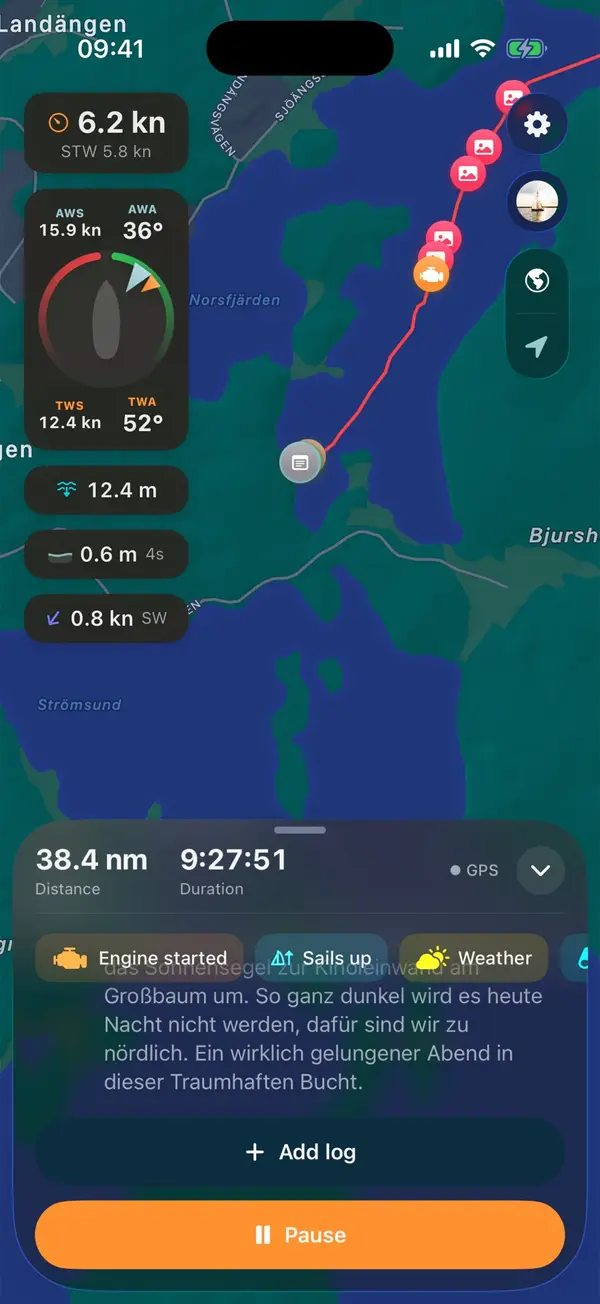
Manta does this for you
Automatic sailing logbook
A digital logbook that fills itself. Manta notices when you cast off, tack, gybe, drop anchor or moor, and writes it into your log by itself. Every automatic entry stays editable.