How to keep a sailing logbook efficiently so one set of notes becomes a trip report, leg overview, illustrated PDF or sea-mile proof with little extra work.
Photo: Katja Ano, Unsplash
To keep a sailing logbook efficiently, decide before you leave what you want to get out of it, write each event down once in a fixed format, and close the day with ten minutes of checking. Done that way, the same entries become a leg overview, a trip report or proof of sea miles without being written twice. The rest of this guide is the method, including how to turn the raw log into something other people will read.
Decide the output before leaving
Each output needs slightly different raw material, and adding it afterwards is hard.
| Output you want | What you must capture along the way |
|---|---|
| Leg overview | Departure, arrival, distance, engine hours per leg |
| Trip report | Decisions and their reasons, moments worth telling |
| Illustrated story or PDF | Photos with correct time, names of places and people |
| Proof of sea miles | Boat, dates, role, night hours, tidal or non-tidal, skipper's signature |
| Maintenance history | Engine meter readings, faults, parts used |
Five minutes at the chart table on the first morning is enough. If someone on board is collecting miles for a Yachtmaster, say so now, because the RYA's route for ocean candidates asks for a narrative account and copies of log pages, and details such as who did the passage planning are hard to reconstruct later.
Three layers of information
Keep the log in three layers, and do not let them mix.
- Trip master data. Boat, skipper, crew and roles, planned route, time reference, units. Written once per trip.
- Chronological record. Time-stamped facts in the order they happened. This is the log proper, and it stays as written.
- Material for the report. Thoughts, photos, names, the story of the evening in the anchorage. Loose and informal, kept separately.
Most logbooks that become useless have all three in the same column, so facts cannot be found and stories cannot be read.
Conventions to fix on day one
Write these on the inside cover or in the first entry of the trip.
| Topic | Decide | Why it matters later |
|---|---|---|
| Date | YYYY-MM-DD or a single written format | Sorting, no confusion between US and UK order |
| Time | UTC or local, and which one | A report that mixes both is wrong by an hour somewhere |
| Distance and speed | Nautical miles and knots | Sea mile claims use nautical miles |
| Course | True or magnetic | A mix makes dead reckoning wrong by the variation |
| Engine | Meter reading and run time, both labelled | The meter is cumulative, a run is the difference |
Responsibility and handover
The skipper is answerable for the log, even when someone else holds the pencil. Name a log keeper for each watch. At handover the outgoing person states what is outstanding, and the incoming person writes the first line, which proves the log changed hands. On a charter week, give one crew member the photos and another the leg overview, and the work spreads without being discussed again.
Keeping a logbook efficiently: a daily rhythm
| When | What to do | Time |
|---|---|---|
| Before departure | Trip data, forecast, engine meter, tanks, camera clock check | 5 minutes |
| Under way | A regular line and one line for each event | Seconds at a time |
| At events | Time first, then what happened | One line |
| After mooring | Close the day | 10 minutes |
The ten-minute close of day is the step that makes the rest work. Go through the day and check times, add the day's distance and engine hours, take the engine reading, write down the three things worth telling, and flag anything to fix. Do it before the first drink ashore, because after that it does not happen.
Separate observation, decision and action
Under pressure people write what they concluded and lose what they saw. Keep these three visibly apart in any entry that matters. Here is a sample:
14:20 OBS  Baro down 3 hPa in 3 h. Line of cloud building W. Wind W 15 gusting 22.
14:25 DEC  Skipper: no rounding of the headland today. Divert to Salcombe.
14:30 ACT  Second reef in. Course 035. ETA 16:40. Crew informed.
This takes three lines and lets anyone reconstruct what happened. Separate an observation from an assumption too. "Depth 4.2 m" is an observation. "Should be fine over the bar" is an assumption, so write it as one, for example ASSUMED: 0.8 m over the bar at HW+1.
Corrections stay traceable
Nobody needs a neat log, but everyone needs an honest one. On paper, strike through once so the original can still be read, then write the correction beside it with your initials and the time you corrected it. Never erase. If the log matters later in a dispute or insurance claim, an erased line invites suspicion. In a digital log, the equivalent is keeping both the original timestamp and the edited one.
Link photos to events
Photos are only useful in a report if you know when and where they were taken. On the first morning, photograph a clock or the plotter screen with every camera on board and note any offset. Phones set their own time, but a compact camera that has crossed a time zone may be an hour out. Sort by time afterwards and each picture sits next to its log entry.
From log to readable report
- Check the log. Add the leg totals and compare them with the track and the engine meter.
- Build the leg overview. A table of date, from, to, miles, hours and weather in a word.
- Pick what is worth telling. Three to five moments per day at most. Your close-of-day list already has them.
- Add photos. One per moment, placed by time.
- Write it up. Put the plain facts first and let the story follow them.
Keep the original log and the edited report apart. The log stays as it was written, and the report can be shortened, reordered and made kinder. If you merge them you lose the record.
PDF template or finished PDF
"Sailing logbook PDF" means two different things. A PDF template is an empty form to print and fill in, while a finished PDF is a document made from your data, such as a report or certificate. Before you share a finished PDF, read it as an outsider would. Remove crew surnames, phone numbers and addresses unless they agreed to be included. Check home ports, marked mooring positions and dates that say when the boat will be left unattended. Ask crew before publishing photos of them.
No authority sets a universal format for a private logbook. In the UK, the RYA lists a log book as recommended equipment. Elsewhere, check with your flag authority or sailing association. What goes in each line is covered in what to write in a logbook, and how paper and digital compare is in digital vs paper logbook.
Capture once in Manta
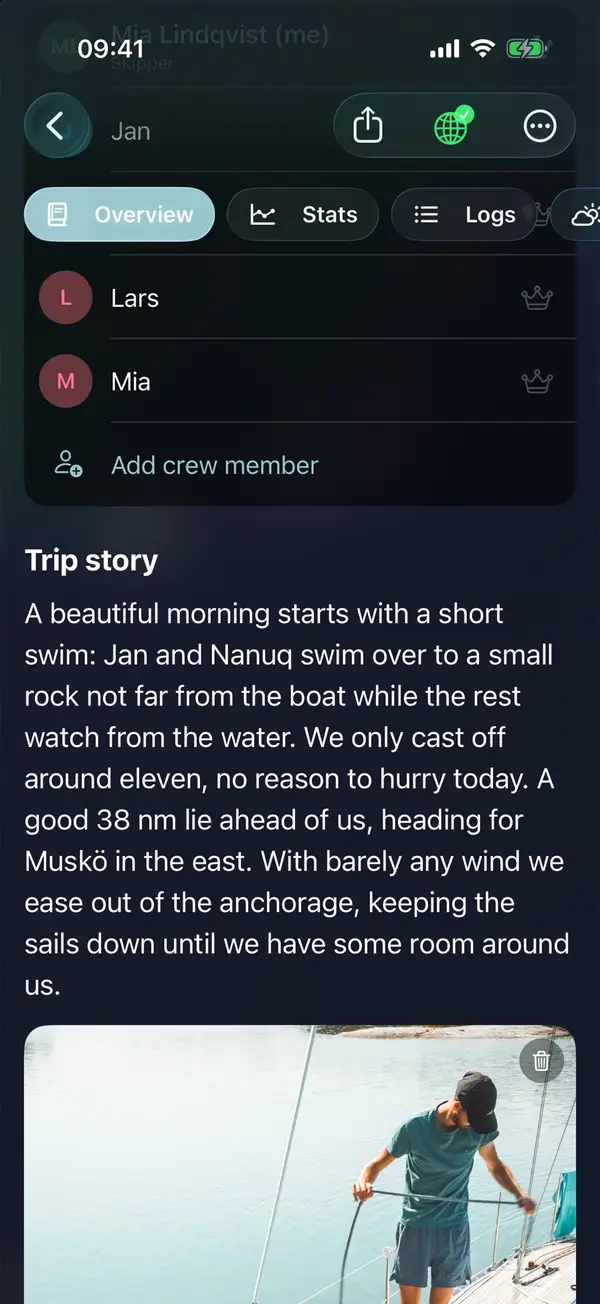
Manta holds the chronological layer on its own: the track, automatic entries with a small sparkle mark, and your manual notes, photos placed by time and location. Stories (Pro) turn track, weather and notes into a written trip report, keep your own notes word for word, need a connection to write, and export as PDF, RTF or Word. Your own handwritten stories are free. Mileage certificates (Pro) produce the proof of miles. Manta has no page-by-page PDF of the logbook itself, so if you need that, keep a paper log or a printed template alongside it.
Questions
How do I keep a sailing logbook efficiently?
Decide what you want from it before leaving, capture each event once in a fixed format, and spend ten minutes closing the day after you moor. Reports then come from the log with little extra writing.
Where can I get a sailing logbook as a PDF?
There are two different things. A PDF template is a blank form you print and fill in. A finished PDF is a report or certificate made from your entries. Decide which you need, because a template does nothing to organise your notes.
Can I correct an entry in the logbook afterwards?
Yes, but keep it traceable. On paper, strike through once so that the original stays legible, and initial it. In a digital log, keep the original time and add the corrected one.
Who should write the log on a charter boat?
The skipper stays responsible, but the person on watch normally writes. Agree at the first briefing who writes what, and hand the log over explicitly at each watch change.
Manta does this for you
Turn your sailing trip into a written story Pro
From your track, the weather and your notes, Manta writes the story of the day, chapter by chapter, and places your photos by time and location.