An honest comparison of keeping your sailing log on paper or in an app, covering what each does well, where each falls short, and why many sailors use both.

Neither is simply better. A paper logbook never runs out of battery and is accepted everywhere; a digital logbook records far more, mostly on its own, and can't get lost in one wet cockpit. Many sailors combine them: the app records, and a short paper note covers the position on longer passages.
At a glance
| Paper | Digital | |
|---|---|---|
| Power | None needed | Needs a charged phone or tablet |
| Effort | Every line by hand | Track and many entries recorded automatically |
| Detail | What you write down | Full track, speed, and instrument data if connected |
| Backup | One copy, unless you photograph it | Synced or exported copies |
| Searching | Leafing through pages | Search, maps, statistics |
| Signatures | Easy | Usually printed or confirmed separately |
| Water and sun | Pencil works when wet | Screens struggle in bright sun and rain |
Strengths of paper
- Always works. No battery, no update, no app crash.
- Simple and familiar. Everyone on board can read and write it, and a skipper can sign it.
- Forces you to look. Writing the barometer every hour makes you notice its trend.
Weaknesses of paper
- It depends on discipline. In bad weather, at night or with a busy crew, entries get skipped, exactly when they matter.
- One copy. Lose the book, lose the season.
- No track. You get the positions you wrote down, not the line you sailed in between.
- Hard to use later. Totalling sea miles for a licence means adding up pages by hand.
Strengths of digital logbooks
- Records without you. The track, speed and distance are there even when nobody had a free hand.
- More data. Connected to the boat's instruments, an app logs wind, depth and speed through the water continuously, not once an hour.
- Backed up. Synced copies survive a lost or broken phone.
- Useful afterwards. Maps, replays, charts and season totals instead of a stack of pages.
Weaknesses of digital logbooks
- Battery. GPS recording uses power over a long day. Plan a charger or power bank.
- The device itself. Phones get dropped, wet or too hot in the sun.
- Formal use. Some authorities and exam boards still expect paper forms or signatures.
Recommendation
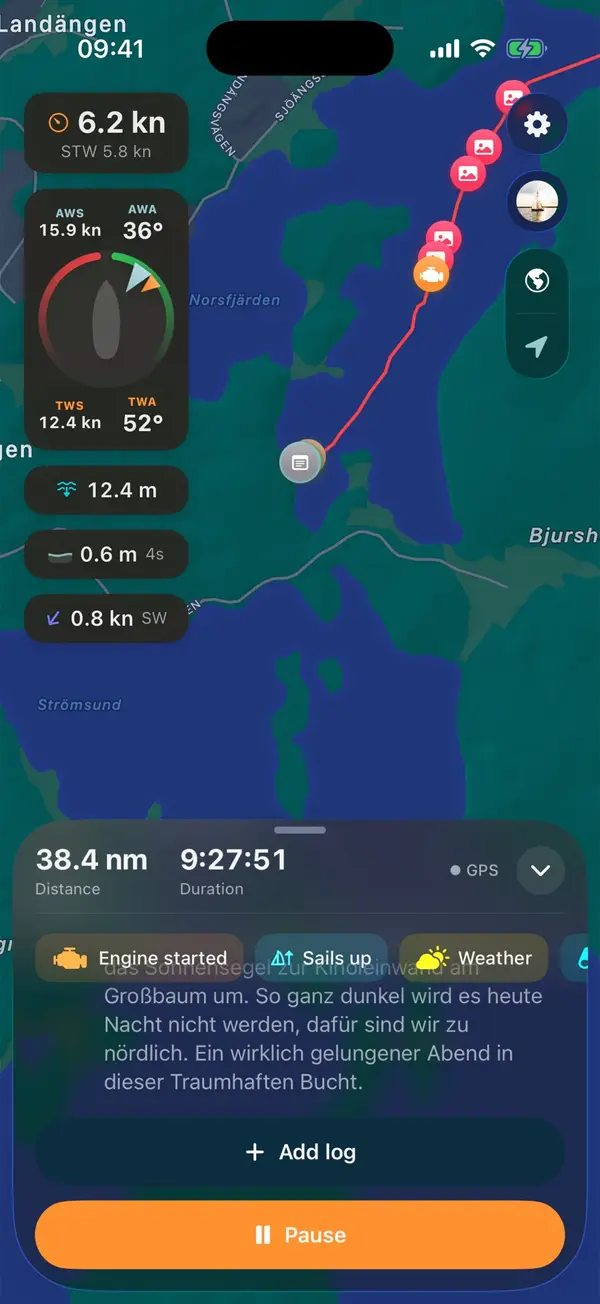
Let a logbook app do the recording and keep paper as a backup where it counts. Manta, for example, records with your iPhone's GPS alone, writes departures, arrivals, tacks, gybes and anchoring into the log by itself, works offline, and syncs through your private iCloud. On a long passage, a pencilled position every hour or two costs you a minute and covers the case where the phone doesn't make it.
What belongs in either kind of log is in What to write in a logbook.
Questions
Is a digital logbook accepted for sea miles?
Licensing bodies usually want the miles confirmed and signed by the skipper, often on their own form. A digital log is good evidence behind that signature, but check with your exam board what they accept.
What if my phone dies at sea?
The entries already recorded are safe, but nothing new is logged until it has power again. That's why a charger on board, and a paper backup for position on passages, is sensible.
Can I take my digital logbook to another app?
Many apps can export your trips. Manta exports any trip as a GPX file for other apps and plotters, or as a .manta file that keeps its log and story.
Manta does this for you
Automatic sailing logbook
A digital logbook that fills itself. Manta notices when you cast off, tack, gybe, drop anchor or moor, and writes it into your log by itself. Every automatic entry stays editable.