The time in seconds between two successive wave crests passing the same point.
The wave period is the time, in seconds, between two successive wave crests passing a fixed point, a buoy, say, or your boat at anchor. Together with the significant wave height, it decides what a sea state feels like: the same 2 m can be a gentle swell or a punishing chop.
Period, length and speed
In deep water, period, wavelength and wave speed are tightly linked:
- wavelength ≈ 1.56 × T² metres
- wave speed ≈ 1.56 × T m/s, or about 3 × T knots
A wave with a 4-second period is about 25 m long; one with 10 seconds about 156 m. In shallow water, waves slow down, get shorter and steeper.
What it means on board
- Short period (under about 6 s): typical of a young wind sea or enclosed waters like the Baltic. The waves are steep, the boat slams and pitches.
- Long period (over about 10 s): typical of swell from distant weather. Long, rounded waves that lift the boat gently, even when they're high.
The steeper the wave (its height relative to its length), the more uncomfortable and, eventually, the more likely it is to break. That's why forecasts give a period alongside the height. Check which one you're reading: forecasts may quote the peak period (of the most energetic waves) or a mean period. More in the guide sea state and waves.
Manta does this for you
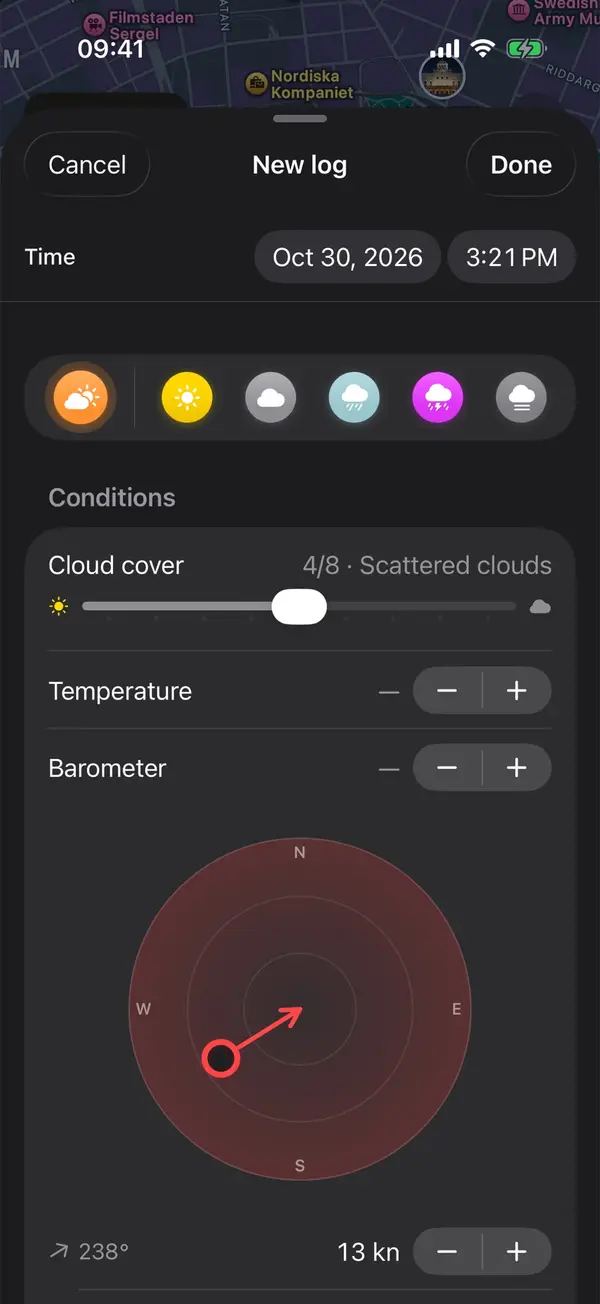
Weather log for every sailing trip
Every trip shows wind, sea state and weather for each hour. Where your instruments are silent, Apple Weather fills the gaps.