The modern marine data network, a CAN bus at 250 kbit/s that connects instruments, plotters and engines with one cable.
NMEA 2000 (N2K) is the current network standard for marine electronics. Instead of point-to-point wires like NMEA 0183, all devices hang on one shared cable, the backbone, and every device can talk to every other. Technically it's a CAN bus (the same technology as in cars) running at 250 kbit/s, based on the SAE J1939 standard.
How it's built
- Backbone: one main cable along the boat, with a terminating resistor at each end.
- Drop cables: short branches from T-pieces to each device.
- Power: the network is supplied with 12 V through a power tap, so small sensors need no separate wiring.
- Connectors: standardised round M12 plugs (Micro-C). Raymarine SeaTalkNG and Simrad SimNet are NMEA 2000 with their own connectors; adapter cables join them.
PGNs
Data is sent as binary messages called PGNs (parameter group numbers), each with a fixed number and content. A few examples:
| PGN | Content |
|---|---|
| 129025 | Position, rapid update |
| 129026 | COG and SOG, rapid update |
| 127250 | Vessel heading |
| 128259 | Speed through the water |
| 128267 | Water depth |
| 130306 | Wind data |
Unlike 0183 text, PGNs aren't human-readable; you need a decoder. To get the data onto a phone or tablet, a WiFi-capable plotter or an NMEA gateway does the job. Manta reads NMEA 2000 in the Yacht Devices RAW format over TCP or UDP. More in the guide NMEA 0183 vs NMEA 2000.
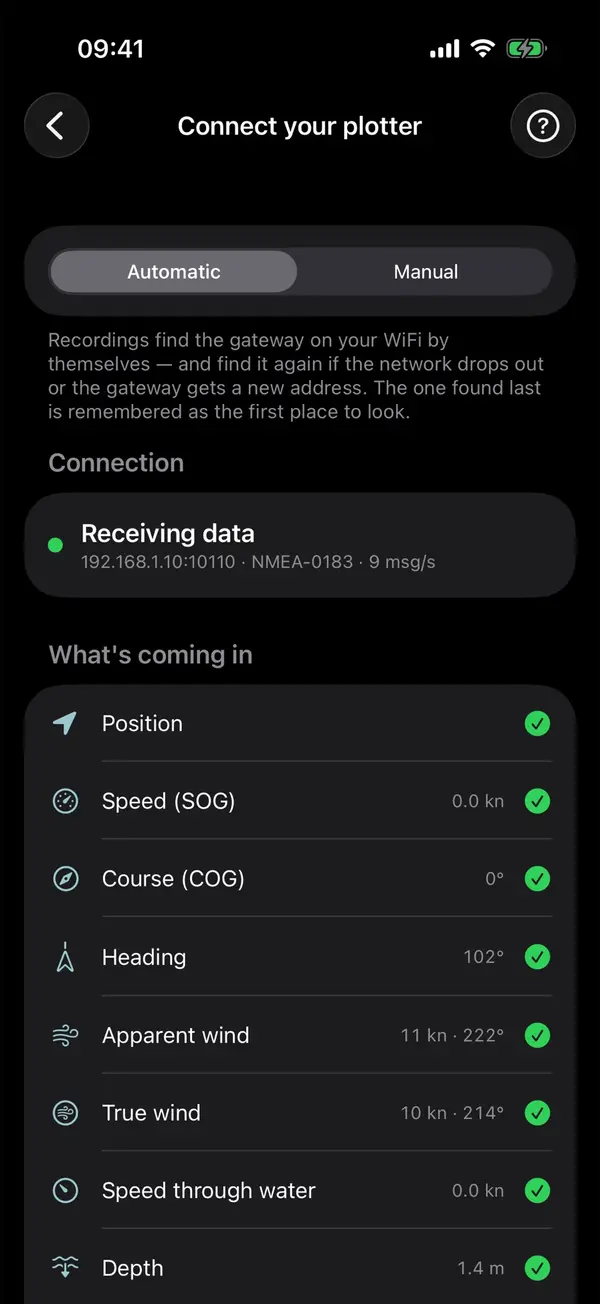
Manta does this for you
Plotter data on your iPhone over WiFi
Connect your plotter or a WiFi gateway, and Manta shows your instruments live and records wind, depth and speed through the water on every trip.