Life jacket servicing explained: what you can check yourself, an inflatable lifejacket service interval table by maker, cartridge weighing and national rules.
Life jacket servicing has two parts: checks you do yourself before the season and at intervals through it, and a service by an authorised station on the schedule your manufacturer sets. Intervals differ by brand, so there is no single rule, and the owner's manual for your model comes first. This guide goes through the self check step by step, the intervals makers actually state, and what the rules are in the UK, Ireland, the US, Australia and New Zealand as of November 2026.
Life jacket servicing: self check or professional service
A self check confirms the jacket still works as far as you can tell: it holds air, the cartridge is full and tight, nothing has expired and the webbing is sound. A professional service goes further. Secumar's service, for example, tests the buoyancy chamber for leaks and the automatic inflation system, and its FAQ says servicing renews gaskets and tests triggering forces. You can't do that on the saloon table, and you must not attempt repairs. Where a manufacturer reserves a job for approved stations, leave it to them.
Step by step self check before the season
Do this somewhere dry at a steady temperature, with the manual in front of you. If you lack confidence in any step, take the jacket to an approved service station.
- Open the jacket following the manual, and look at the whole fabric. Check for cuts, abrasion, heat damage and chemical damage. Crewsaver asks you to look particularly at webbing and stitching.
- Check webbing, harness and crotch straps. Pull every strap, check buckles and the harness attachment, and see that the crotch strap is fitted. MGN 599 (UK) says a lifejacket should have crotch straps, a light and a whistle.
- Test the bladder. Inflate through the oral tube until firm, then leave it for the time your manual gives, at a steady temperature. If it loses firmness, stop using it and contact a service station or replace it. Norway's DSB recommends a pump and not your breath, to avoid adding moisture.
- Check the oral valve. Crewsaver and Spinlock suggest putting the inflated oral tube under water and looking for bubbles.
- Unscrew and check the cartridge. Look for corrosion at the cylinder and where it joins the head. Weigh it on accurate scales against the weight engraved on it. NSW guidance says it should match the minimum gross weight or be within 2 grams; if it's under, rusted, corroded or pierced, replace it. Spinlock's cylinders carry no expiry date, but weighing shows a leak.
- Check the firing head. Check any expiry date printed on the automatic capsule, bobbin or firing cap, and replace anything past it. Mustang advises replacing a bobbin with only a manufacturing date if the year is two or more past it. Refit the cylinder hand tight, and don't overtighten.
- Read the indicators. Status indicators should show green. Crewsaver says a red indicator means checking that the cylinder and capsule are tight and in date, and if there is no plate in the capsule's base and a red dot shows, the capsule has fired. Mustang warns that a green indicator doesn't guarantee a jacket is ready.
- Check the accessories. Press the test button on the light, and look at its terminals for corrosion. Check the whistle, and the sprayhood's attachment, stitching and fabric.
- Deflate fully and repack exactly as the manual says. A wrongly folded jacket can fail to open properly.
Do the test at a steady temperature. A warm afternoon followed by a cold night can make a sound bladder feel soft.
How long the leak test should run
| Source | Duration stated |
|---|---|
| Spinlock | 24 hours |
| Norwegian DSB | 24 hours, using a pump |
| Crewsaver | Overnight or at least 12 hours |
| Mustang Survival | At least two hours, ideally overnight, about 16 hours |
| NSW Australia | Overnight |
Inflatable lifejacket service interval by maker
Intervals differ. These are what the makers state, and your manual overrides this table.
| Brand | Owner check | Professional service | Service life |
|---|---|---|---|
| Secumar | See manual | At least every two years; yearly after 10 years | Average 10 years; no service after 15 years. Lower-priced occasional-use models are yearly, 5 year life |
| Crewsaver | Complete inspection every three months | Yacht NZ listed 12 months as at 2021. SOLAS-approved jackets annually at an authorised station | Bulletin 081: no fixed 10 year limit. For SOLAS jackets, shorter intervals as they age |
| Spinlock | At least yearly; every 3 months if used often, and before long passages or races | See your manual and service centre | Ask Spinlock |
| Mustang Survival (US) | Visual before each use; leak test every six months; annual inspection logged on the label | Contact Mustang if a test fails or you're unsure | See manual |
Yachting New Zealand published a brand list as at June 2021 that also gives Baltic at 12 months, Kru at 24 months, Hutchwilco at 12 months and Burnsco at 12 months. It is out of date as a rule, but it shows how much brands differ.
Common faults
- Loose cartridge. Cylinders can work loose over a season. Make checking this part of your routine.
- Corroded cylinder. Spinlock advises replacing one with corrosion, as it may mean a leak and can damage the bladder.
- Automatic head fired by moisture. Damp penetrates the capsule. Crewsaver advises removing the capsule from a wet jacket until it's dry, and Secumar suggests replacing the tablet after heavy rain or a passage.
- Damp lockers. Ireland's Marine Notice 32 of 2019 notes that bobbin models can activate if left damp and should hang to dry. Store jackets dry and ventilated.
- Out-of-date components. Keep a list per jacket of when each thing expires.
After the jacket has fired
The CO2 cylinder is spent, and the automatic parts may also need replacing. Rinse if it was in salt water and dry it fully. Refit from a re-arming kit intended for that jacket, following the manual. Then test it, or take it to a service station if you are not sure. Carry a spare re-arming kit on board.
National rules, as of November 2026
- UK. MGN 599 says pleasure vessels under 13.7 m are not covered by statutory requirements to carry life-saving appliances, and the RYA lists lifejackets as recommended under that length. On Class XII pleasure vessels of 13.7 m and over they are required and must be serviced according to manufacturer's instructions. MGN 599 also says a properly maintained lifejacket significantly improves your chances if you fall overboard. Check charter and commercial codes separately. The RNLI publishes check guides and runs lifejacket clinics at some stations.
- Ireland. There must be suitable personal flotation devices for everyone on board any pleasure craft in Irish waters, under the regulations described in Marine Notice 32 of 2019.
- US. Under 33 CFR 175.23 an inflatable PFD counts as serviceable only if properly armed with a full cartridge and status indicators showing that, chambers holding air, the oral tube unbroken and the manual lanyard accessible. Read the approval label too, since some inflatable models carry conditions such as being approved only when worn.
- Australia. NSW guidance says lifejackets should be serviced annually or in line with the manufacturer's instructions, and that this is the skipper's responsibility. Other states have their own rules, so check with your state authority.
- New Zealand. Yachting New Zealand says equipment must be serviced as the manufacturer requires. Ask Maritime NZ about carriage.
A simple record for each jacket
Keep one line per jacket: serial number, owner, make and model, date of purchase, cartridge weight, expiry date of each part, date and result of last leak test, date of last service, next service due. Crewsaver serial numbers can show the jacket's age: L 0706 2666 means June 2007. Write the same number on the jacket so the record can't drift from the kit.
In general terms a service costs a fraction of a new jacket, and a re-arming kit costs less again.
Lifejacket reminders in Manta
Manta's maintenance reminders (Pro) can hold one reminder per jacket or per batch of jackets, by date, once or repeating. The setup template suggests life jackets yearly as a starting value, which you edit to match your manual. A coloured chip shows the time left, and marking the job done writes an entry to the boat's maintenance log and restarts the interval. For a wider view see the boat maintenance log and choosing a boat maintenance app.
Questions
How often does a life jacket need servicing?
It depends on the maker. Secumar states a service at least every two years, Crewsaver asks owners to inspect every three months, and Mustang asks for a six-monthly leak test. Follow the manual for your model, and treat a yearly check as the minimum.
Can I service my own inflatable lifejacket?
You can do the owner checks in your manual, such as the leak test, cartridge weighing and checking expiry dates. Repairs and any service the manufacturer reserves for approved stations belong with an authorised service station.
How long should a lifejacket hold air in a test?
Sources differ. Spinlock and Norway's DSB say 24 hours, Crewsaver says overnight or at least 12 hours, and Mustang says at least two hours and ideally overnight, about 16 hours. Use the figure in your own manual.
How much should a CO2 cartridge weigh?
Compare it with the weight engraved on the cylinder. NSW guidance allows it to be within 2 grams of the minimum gross weight. Replace a cylinder that is under weight, rusted, corroded or pierced.
How long does an inflatable lifejacket last?
Secumar gives an average life of 10 years, with yearly service after that and no service after 15 years. Crewsaver says jackets should not simply be limited to 10 years, and shortens the service interval as they age. Ask your service station.
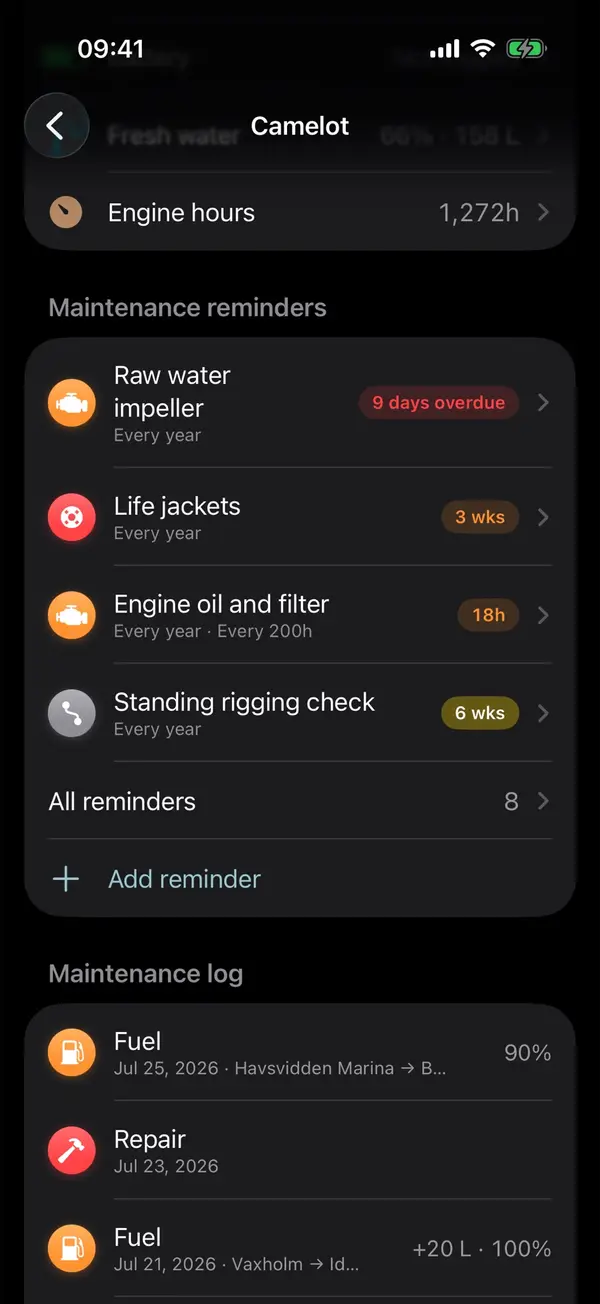
Manta does this for you
Maintenance reminders for your boat Pro
Get reminded when a job on your boat is due, by date, engine hours, sailing time or distance.