How often to antifoul a boat: usually every one to three seasons, depending on paint, water and use, with UK, US, Australian and New Zealand rules as of 2026.
How often to antifoul a boat depends on the paint, the water and how the boat is used, but it is typically every one to three seasons. A boat afloat year round in warm salt water may need it every year, while one kept on a trailer or ashore between trips may go longer. Judge it at haul-out, with the paint in front of you. Because the rules are national, this guide says which country each one applies to, as of November 2026.
What decides how often to antifoul
| Factor | Pushes the interval shorter | Pushes it longer |
|---|---|---|
| Paint | Thin coats of eroding paint | Multiple coats of a two-season product |
| Water | Warm, salt, nutrient-rich | Cold, or fresh water |
| Use | Long periods at a mooring without moving | Regular sailing, or kept ashore |
| Boat speed | High speed wears ablative paint | Moderate speed |
| Storage | Afloat all winter | Hauled or dry-stored |
International's data sheet for Micron 350 shows how directly the coating itself sets this: two coats at 60 microns dry give 12 months, and three coats give 24 months. The paint is also rated for applying up to 12 months before launch, and it warns that boats regularly at high speed, for example 30 knots, may wear through early.
Hard, eroding, self-polishing and biocide-free paints
| Type | How it works | How it ages | Suits |
|---|---|---|---|
| Hard | Biocide releases from a surface that barely wears | Release slows over seasons, residue builds and may need removing | Faster boats, racers, fresh water |
| Eroding or ablative | Paint slowly washes off as it releases biocide | Less build-up, but excess over the years becomes unstable | Salt water, mixed use |
| Self-polishing copolymer | Controlled erosion that smooths over time | Designed for longer gaps between work | Longer service intervals |
| Biocide-free silicone or foul release | A slick surface that fouling struggles to grip | Fails when the surface gets scratched or dirty | Owners willing to clean more or to apply carefully |
International notes that eroding paints may not erode well in fresh water, so check the sheet if you are on a river or lake. Practical Boat Owner reported in October 2025 that the UK has biocide-free DIY options, among them products from Hempel and Seajet, and that silicone systems are harder for amateurs to apply.
Judging the coat at haul-out
Do this on the first day ashore, when the hull is wet and fouling is still visible.
- Look at the pattern of fouling. Slime is normal. Barnacles on the bottom or along the waterline say the paint has given up there.
- Wet rub with a gloved hand on a small patch. A self-eroding paint that still has life shows colour coming off in a cloud. No colour may mean the biocide layer is gone.
- Check for a contrasting undercoat showing through. Many owners use two colours for this reason. If the undercoat shows widely, that area is finished.
- Press with a fingernail. Hard paint should feel solid, not chalky or soft.
- Look at edges and high-wear spots: keel leading edge, rudder and waterline. These go first, and International says to give them an extra stripe coat.
- Count the layers on a scraped test patch. Thick, flaking or cracked paint needs stripping, whatever its age.
Write the result down with photos so that next year's judgement has something to compare against.
Water and use
Salt or brackish water with a warm summer keeps fouling going all season. Fresh water brings less barnacle pressure but different slime and sometimes zebra mussels on inland waters, and eroding paints work less well there. A boat that rarely leaves its mooring fouls faster than one sailing every week. A trailer boat or dry-stack boat often has no need of a full antifouling at all, and you should check the paint's limits before leaving it out of the water for long.
Mid-season scrubs
Most eroding paints shouldn't be scrubbed hard, since you take paint off with the fouling. Use a soft cloth or sponge. Remember that pollution rules apply here too.
In England, Falmouth Harbour's guidance quotes the Marine Management Organisation: no marine licence is needed for in-water hull cleaning done by hand with a soft cloth, a sponge, soft-bristle brush or sandpaper with a grit size of at least P2000, and this exemption does not apply when the boat is beached or in a scrubbing bay. Falmouth also warns that pressure washing or scraping without containing the wash water and scrapings is an offence under the Environmental Permitting Regulations 2016, and that the waste counts as hazardous. Scotland, Wales and Northern Ireland have separate licensing, so ask your harbour authority or local regulator.
Build-up and when to strip
International warns against excessive build-up of aged antifouling layers, because solvents in fresh paint can soften those below and cause sling marks. Layers accumulate faster with hard paint than with eroding paint. As a practical test, if the paint is uneven, flaking or peeling, or if a fresh coat lifts the one below, it is time to strip back. Use a chemical stripper or a professional blaster, not dry sanding.
Drying and launch windows
Read the product sheet for your paint and temperature. For Micron 350, the minimum time before immersion is 24 hours at 5°C, 18 hours at 15°C, 10 hours at 23°C and 8 hours at 35°C, and the maximum is 12 months. Overcoating takes 16 hours at 5°C and 10 hours at 15°C. Substrate temperature must be at least 7°C. Those figures are for one product, so check yours, and allow for a cold night.
National rules, as of November 2026
Great Britain. Antifoulings are biocidal products, regulated under the GB Biocidal Products Regulation or the older Control of Pesticides Regulations (COPR). HSE says the public must never use biocides intended only for professionals, and an approved label carries an HSE number or authorisation number. Practical Boat Owner reports that antifoulings with booster biocides such as zinc pyrithione and copper pyrithione can no longer be sold to consumers. HSE publishes the COPR product list, including user category. Northern Ireland falls under EU rules, so check there separately. Local rules may ban washdown without containment, as Falmouth's does.
USA. Washington State banned irgarol paints on recreational vessels from 1 January 2023, and its Department of Ecology says the restriction on copper-based paints will not take effect in 2026; a new report is due by 30 June 2029. California has a maximum copper leach rate of 9.5 micrograms per square centimetre per day for paints registered for recreational vessels. Other states and marinas have their own rules, so check locally.
New Zealand. An EPA decision in 2013 requires a controlled work area, protective equipment and proper collection and disposal of antifouling waste. Biosecurity rules apply on arrival too. A 2018 summary said long-stay yachts needed a clean hull, cleaned within 30 days before arrival or within 24 hours after, with evidence such as receipts and dated photos. The standard has been revised since, so check the Ministry for Primary Industries' current page before crossing the Tasman.
Australia. Ask the Australian Pesticides and Veterinary Medicines Authority about product registration, and your state environment regulator about removal and washdown.
Sanding safety and waste
Follow the data sheet: International says never to dry sand or burn off old antifouling. Wet sand only, wear gloves and eye protection, and use the respirator the product's safety sheet specifies. Catch everything on a tarpaulin or with a vacuum sander, and take scrapings to a hazardous waste point, not the general skip. Bunded washdown areas that collect runoff are the right place to pressure wash. The Green Blue says pressure wash runoff needs to be contained and filtered.
Antifouling records in Manta
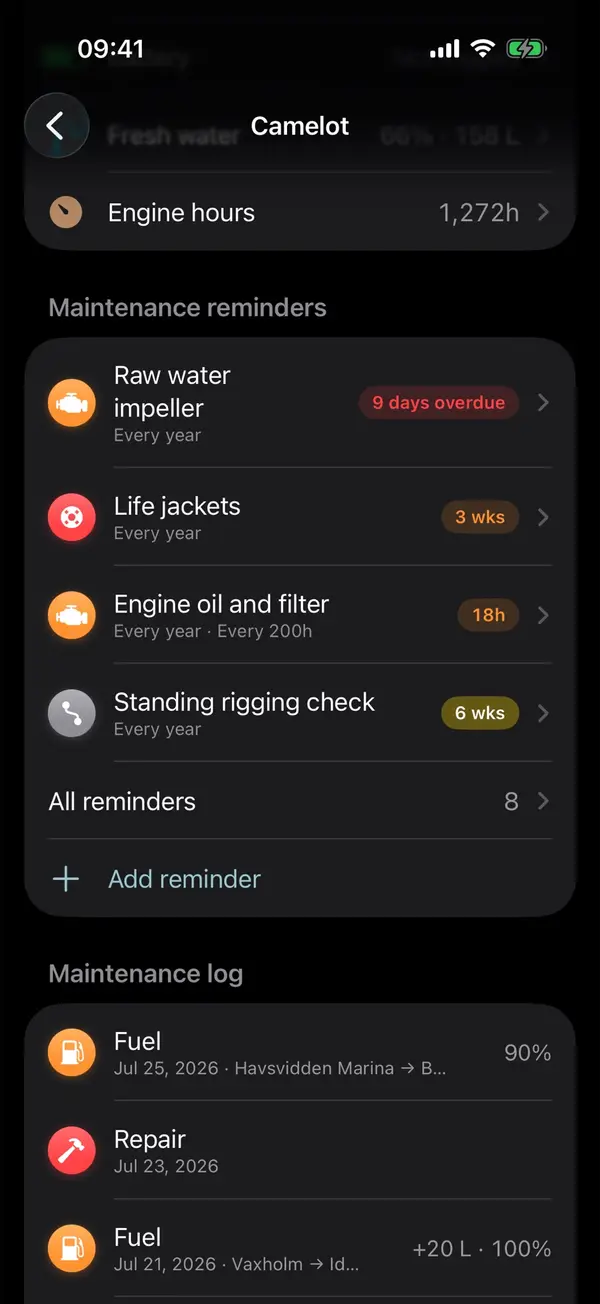
The maintenance log (Pro) has an antifouling entry type where you note the product, coats and date with photos of the hull, and a maintenance reminder (Pro) can be set for the next season. For how to record the rest of the work, see the boat maintenance log and choosing a boat maintenance app.
Questions
How often should you antifoul a boat?
Usually every one to three seasons, depending on the paint, the water and how the boat is used. A boat kept afloat all year in warm salt water needs it more often than one stored ashore between trips.
Is antifouling a legal requirement?
No general rule makes you antifoul a private boat, as far as we know, but rules do govern which paints may be used and how they are removed. New Zealand also requires a clean hull on arrival, so check before crossing a border.
Can I scrub my boat in the water?
It depends on where you are. In England, the MMO exempts gentle hand cleaning in the water from a marine licence with soft materials, as summarised by Falmouth Harbour. Other nations and harbours differ, so ask your harbour authority first.
Can I use professional antifouling myself in the UK?
No. HSE says members of the public must not use biocidal products intended only for professional users. Check the label and its HSE number before buying.
When do I need to strip old antifouling?
When it is thick, flaking or cracked and new paint won't bond well. Antifouling manufacturers warn that excessive build-up of old layers can cause problems with new coats.
Manta does this for you
Maintenance reminders for your boat Pro
Get reminded when a job on your boat is due, by date, engine hours, sailing time or distance.