What the common recreational sailing licences require and allow (Germany's SBF See to SHS, the RYA ladder, the ICC, US Sailing and ASA, the Danish, Norwegian and Swedish certificates), with an interactive picker, a comparison table and a recommendation per type of sailor.
There is no single sailing licence that works everywhere. What you need depends on four things: the flag of the boat, the country you sail in, the size and engine of the boat, and whether you are paid to be on board. For private sailing on your own boat, a surprising number of countries require nothing at all; for a bareboat charter, the charter company's rules apply on top of the law; and for carrying passengers for money there is always a separate professional licence. This guide compares the licences you are most likely to meet (Germany's ladder from the SBF See to the SHS, the RYA ladder up to Yachtmaster Ocean, the ICC, the US certificates from ASA and US Sailing, and the Danish, Norwegian and Swedish certificates) and says which one fits which kind of sailor.
Four rules for comparing licences
- The flag decides what is required, the coast decides what is accepted. A boat follows the rules of the country it is registered in. The country you are visiting can additionally ask foreign skippers for proof of competence. That is what the ICC is for.
- Required and recommended are different things. In Germany only the SBF See is legally required at sea; the SKS, SSS and SHS are recommended for their sea areas and only become mandatory on commercially used boats. In the UK and the USA nothing is required for private sailing. Many of the licences below are qualifications, not permits.
- Charter companies set their own bar. A base will typically want a coastal licence, a radio certificate and a sailing CV, whatever the local law says, and the rules differ by country and by company.
- The radio certificate is separate. Everywhere in Europe the person using the VHF needs an operator's certificate (SRC or equivalent); for the RYA Yachtmaster exams and for German commercial use it is a formal prerequisite.
Pick a licence
Pick a country or body, then a level on its ladder. The picture shows how far from the coast the licence takes you and which boats it covers; below it, what the licence allows privately and commercially, and what you need for it.
Sportbootführerschein See (SBF See)
German pleasure-craft licence for sea waterways, the only one required by law for private sailing
Privately
- No legal distance limit for private sailing
- Required within 3 nm of the coast (sea waterways)
- Sail and power · any size
- The card is an ICC, accepted for charter abroad
Commercially
- Private use only
What you need
- Age
- From 16
- Licence before
- No
- Theory exam
- Yes
- Practical exam
- Yes
- Medical
- Yes
- Radio certificate
- No
- Sea miles
- —
- Days at sea
- —
- Night hours
- —
- Passages
- —
Requirements, cost and where to take it
Requirements
- From 16 (18 on Lake Constance); medical certificate for eyesight and hearing; a copy of your driving licence or a police certificate
- Theory exam of 39 multiple-choice questions in 60 minutes, including a chart task
- Short practical exam on a motorboat (berthing, man overboard, steering by compass); no sea miles
What it allows
- Required on German sea waterways (up to 3 nm off the baseline) for any boat with an engine over 11.03 kW (15 hp); beyond that no licence is required for private boats
- No length or power limit; sailing yachts with an auxiliary engine included
- Private use only; the card is issued as an ICC (coastal, motor) under UNECE Resolution 40
- Accepted by charter bases in Croatia and Italy with the SRC; in Greece often not on its own
Time and cost
Official fees about €148 for admission, both exams and the card; courses €150–450 on top, so most people spend €250–600. One weekend to a few weeks.
Where to take it
Regional exam committees of the DSV and DMYV; theory at a sailing school, online or by self-study.
ELWIS · official bodySpFV · the rulesDSV / DMYV · courses and exams
Side by side
Every licence on one row: how far it takes you, which boats, whether the law requires it, whether it covers paid work and whether it counts as an ICC, followed by the miles, days and exams it asks for. The ICC, or International Certificate of Competence, is the internationally agreed proof of a skipper's competence under UNECE Resolution 40; foreign authorities and charter bases ask visiting skippers for it. A distance marked recommended or certified is not a legal limit: German law only recommends the SKS, SSS and SHS for their waters, and the UK and the USA require no licence for private sailing, so their certificates describe what you are trained for. The table scrolls sideways; the licence column and the header stay in place.
| Licence | Distance from the coast | Boat | Required by law | Commercial | ICC | Sea miles | Days at sea | Night hours | Passages ≥ 60 nm | Exam | Medical | Radio certificate |
|---|---|---|---|---|---|---|---|---|---|---|---|---|
| DESBF See | 3 nm · required zone | Sail and power | No | Is an ICC | — | — | — | — | Theory exam + Practical exam | |||
| DESKS | 12 nm · recommended | Sail and power | Yes | Is an ICC | 300 | — | — | — | Theory exam + Practical exam | |||
| DESSS | 30 nm · recommended | Sail and power | Yes | Is an ICC | 1,000 · 700 after the SKS | — | — | — | Theory exam + Practical exam | |||
| DESHS | No limit · recommended | Sail and power | Yes | Is an ICC | 1,000 | — | — | — | Theory exam | |||
| UKDay Skipper | 20 nm · certified | Sail and power ≤ 24 m | With endorsement | Extra step | 100 | 5 | 4 | — | Theory exam + Practical exam | |||
| UKCoastal Skipper | 20 nm · certified | Sail and power ≤ 24 m | No | Extra step | 300 | 15 | 8 | — | Theory exam + Practical exam | |||
| UKYachtmaster Coastal | 20 nm · certified | Sail and power ≤ 24 m | With endorsement | Extra step | 800 | 30 | 12 | — | Theory exam + Practical exam | |||
| UKYachtmaster Offshore | 150 nm · certified | Sail and power ≤ 24 m | With endorsement | Extra step | 2,500 | 50 | — | 5 × ≥ 60 nm | Theory exam + Practical exam | |||
| UKYachtmaster Ocean | No limit · certified | Sail and power ≤ 24 m | With endorsement | Extra step | — | — | — | 1 × ≥ 600 nm | Theory exam | |||
| INTICC | Per country | Sail and power | No | Is an ICC | — | — | — | — | Theory exam + Practical exam | |||
| USASA 104 · Bareboat | Sight of land · certified | Sail ≤ 14 m | No | Extra step | — | — | — | — | Theory exam + Practical exam | |||
| USASA 106 · Coastal | 200 nm · certified | Sail ≤ 15 m | No | Extra step | — | — | — | 1 × ≥ 50 nm | Theory exam + Practical exam | |||
| USASA 108 · Offshore | No limit · certified | Sail | No | Extra step | — | — | — | 1 × ≥ 600 nm | Theory exam + Practical exam | |||
| USUSCG OUPV | 100 nm | Sail and power | Yes | No | — | 360 | — | — | Theory exam | |||
| DKDuelighedsbevis | Sea areas | Sail and power ≤ 15 m | No | No | — | — | — | — | Theory exam + Practical exam | |||
| DKYachtskipper 3 | Sea areas | Sail and power ≤ 24 m | With endorsement | No | — | — | — | — | Theory exam | |||
| DKYachtskipper 1 | No limit | Sail and power ≤ 24 m | With endorsement | No | — | 6 months | — | — | Theory exam | |||
| NOBåtførerbevis | No limit | Sail and power ≤ 15 m | No | Extra step | — | — | — | — | Theory exam | |||
| NOD5L | Sea areas | Sail and power ≤ 24 m | With endorsement | Extra step | — | — | — | — | Theory exam + Practical exam | |||
| NOD5LA | No limit | Sail and power ≤ 24 m | With endorsement | Extra step | — | — | — | — | Theory exam | |||
| SEFörarintyg | Sheltered · certified | Sail and power ≤ 12 m | No | No | — | — | — | — | Theory exam | |||
| SEKustskepparintyg | No limit | Sail and power | No | No | — | — | — | — | Theory exam + Practical exam | |||
| SEUtsjöskepparintyg | No limit · certified | Sail and power | No | No | — | — | — | — | Theory exam | |||
| SEKlass VIII | Sheltered | Sail and power | Yes | No | — | 24 months | — | — | Theory exam |
Distance: Distance from the coast · By law: Required by law · Paid: Commercial
— = not required or no limit. A distance marked recommended or certified is not a legal limit. Figures as of the date checked; the issuing bodies' current rules apply.
Which licence is the strongest?
The RYA Yachtmaster Offshore is the qualification that travels furthest. It is examined, not taught, it is built on documented sea time rather than a course, and with the commercial endorsement it is accepted as a master's certificate on small commercial yachts under the British flag and listed by Spain and others for charter. The German SHS reaches the same waters, worldwide, but is theory-only on top of the SSS, and outside German-speaking charter bases few people know it. Denmark's Yachtskipper 1 and Norway's D5LA are strong national certificates for big boats, but they are rarely asked for abroad.
The real differences are not in the names:
- Sea-time licences versus course licences. The RYA Yachtmaster exams and the German SSS and SHS require miles, days or passages before you may sit the exam. The RYA Day Skipper, ASA 104, Förarintyg and Kustskepparintyg are courses or theory exams with little or no experience requirement.
- What the sea time counts. The RYA counts days living aboard, night hours, passages over 60 miles and tidal waters; the German licences count miles only, and for the SSS and SHS only miles sailed after the previous licence; Denmark's Y1 and the USCG count months and days of service.
- Practical exam on a yacht. The German SKS and SSS, the RYA Yachtmaster exams and the Danish duelighedsprøve test you afloat; the SHS, Y3, Y1, D5LA, Båtførerbevis and the Swedish intyg do not.
- Commercial use. German licences include it by sea area; the RYA needs an endorsement; the US and Sweden have separate professional licences; Denmark and Norway allow small-boat passenger work with extra certificates.
- International recognition. For private sailing it is the ICC that counts, not the national name behind it. Germany, the Netherlands, Finland and Norway issue it on the back of their national licences; the UK issues it to residents; Denmark and Sweden do not issue it at all, and France, Italy, Spain, Portugal and the USA have not adopted it, even if their charter bases accept it.
Choosing a licence
- Baltic or North Sea weekend sailor on your own boat. Under the German flag, the SBF See is all the law asks once the engine is over 15 hp; the SKS is the sensible next step and the one that counts for charter. Under a Danish or Swedish flag you need nothing under 15 m or 12 × 4 m, but the duelighedsbevis or Kustskepparintyg is the recognised standard and the base for everything above. Under a Norwegian flag the Båtførerbevis is mandatory if you were born in 1980 or later. Add the SRC as soon as there is a VHF on board.
- Chartering abroad. Get an ICC in whatever way your country offers: the German cards already are one, Norway and the Netherlands issue it, UK residents get it from the RYA on a Day Skipper practical. Take the SRC, and the certificate the base names: SKS or Day Skipper plus ICC in Greece, ICC or SBF See plus VHF in Croatia, ASA 104 or US Sailing Bareboat plus a sailing CV in the Caribbean. Danes and Swedes without an ICC sail on their national certificate and a sailing CV; ask the base before booking.
- Offshore ambitions. Collect the numbers from the first season (miles, days aboard, night hours and passages over 60 miles) and decide later between the RYA Yachtmaster Offshore and the German SSS. The RYA route counts more kinds of experience, is examined afloat and is known worldwide; the German route needs fewer formalities and leads to the SHS and worldwide commercial use under the German flag. Legally, your own German-flagged yacht needs only the SBF See, even offshore. The SSS and SHS are recommended and are what charter companies ask for.
- Working on boats. Under the British flag the Yachtmaster Offshore with commercial endorsement is the standard skipper's ticket for coded yachts up to 24 m; under the German flag the SKS, SSS or SHS by sea area plus a radio certificate; in the USA the USCG OUPV or Master licence; in Norway the D5L covers small boats with up to 12 passengers, in Denmark the Y3 can stand in for the merchant proficiency exam on such boats; in Sweden the Fartygsbefäl klass VIII. Everything larger needs professional STCW certificates.
Other national licences
The Netherlands, France, Italy, Spain, Portugal and Finland all have their own ladders. They matter if you sail under those flags or charter a locally flagged boat; visitors on their own boat are generally covered by their flag state's licence or an ICC.
| Country | Required when | Ladder | Limits | Typical cost |
|---|---|---|---|---|
| Netherlands | Motorboats under 15 m faster than 20 km/h; all craft of 15–25 m | Klein Vaarbewijs I (rivers, canals, lakes), Klein Vaarbewijs II (adds IJsselmeer, Wadden Sea, Scheldes), Groot Pleziervaartbewijs (25–40 m) | Theory only, from 18; every vaarbewijs since 2010 is an ICC (KVB II with coastal category) | Exam about €53–63, card €12.70 |
| France | Motorboats over 4.5 kW (6 CV); sailing boats at sea are exempt | Permis plaisance option côtière (6 nm from a shelter), extension hauturière (no limit), option eaux intérieures, grande plaisance (over 20 m inland) | Côtière: from 16, 40-question test, 3½ hours of practice at a school; hauturière: chart and tide exam only | State fees €108 for the côtière, €38 for the hauturière; schools several hundred euros |
| Italy | Beyond 6 nm from the coast, for engines over 30 kW (40.8 CV), and always on PWC | Patente nautica entro 12 miglia, senza alcun limite (unlimited), categoria B for boats over 24 m | From 18, medical, quiz, chart work, 5 hours of practice and a practical test; motor or motor and sail | State fee €65.95 plus stamps; schools €1,100–1,800 |
| Spain | Motorboats over 5 m or 15 CV, sailboats over 6 m, beyond 2 nm or at night | Licencia de Navegación (6 m, 2 nm), PNB (8 m, 5 nm), PER (15 m, 12 nm, with habilitaciones to 24 m and sail), Patrón de Yate (24 m, 150 nm), Capitán de Yate (24 m, no limit) | Theory exam plus set practice hours (16 h for the PER, 48 h with a day-and-night passage for Patrón de Yate) and the ROCA radio course | Regional exam fees €36–68; a PER all-in about €600–900 |
| Portugal | Always, by category | Marinheiro (3 nm), Patrão Local (6 nm from the coast, 25 nm from shelter, day and night), Patrão de Costa (40 nm), Patrão de Alto Mar (no limit) | Medical within 6 months, swimming, accredited course, theory and practical exam; valid to age 70 | DGRM fee €115–185; schools €275–910 plus exam |
| Finland | Only for pleasure craft over 24 m (ICC required); otherwise no licence, minimum age 15 | Saaristolaivuri, rannikkolaivuri and avomerilaivuri exams of the Navigation Federation, voluntary and held four times a year; the ICC from Traficom on the basis of saaristo- and rannikkolaivuri plus a practical certificate | ICC from 16 with a driving licence; theory and practice from Traficom-audited providers | ICC €110 online; club courses and 30 € per certificate |
None of these six countries issues ICCs for maritime use except the Netherlands and Finland; France, Italy, Spain and Portugal still apply the older Resolution 14, so their permits are national documents, and EU nationals sail their boats on the licence of their own country within its limits.
Recording miles from the first trip
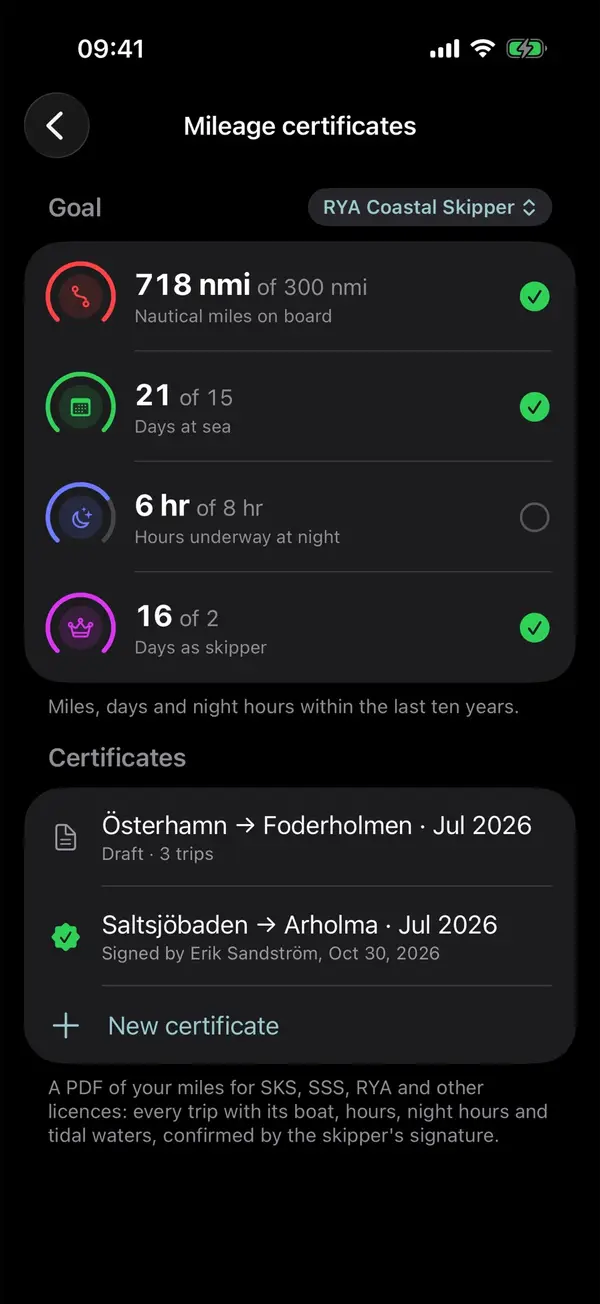
Every licence above that asks for experience asks for the same handful of figures: miles, days at sea, night hours, passages over a certain length, time as skipper, and for the RYA whether the water was tidal. They are easy to lose over a few seasons and painful to reconstruct. Manta records them trip by trip (the distance actually sailed, the dates, the hours after dark, passages over 60 miles, tidal waters and your role on board) and sums them per person. When you apply, it produces a mileage certificate with the trips listed and the skipper's signature on it, in the form most bodies accept alongside their own paperwork. The exam boards still decide what counts; the record is what you bring.
How to document the miles themselves is in How to prove your sea miles, and the German specifics in Sea miles for the German SKS licence.
Questions
Which sailing licence is recognised in most countries?
For private sailing, the ICC (International Certificate of Competence) is the document most European authorities and charter companies ask visitors for. But it is a passport, not a qualification, and a few countries (notably the USA) do not recognise it. Among qualifications, the RYA Yachtmaster Offshore is the one most widely known, and with a commercial endorsement it is accepted on small commercial yachts far beyond the UK.
Do I need a licence to sail at all?
It depends on the flag of the boat and where you sail. Sweden, Finland and Denmark require nothing on most boats under 12 to 15 metres; Norway requires the båtførerbevis for anyone born in 1980 or later; Germany requires the SBF See as soon as the engine exceeds 11.03 kW; the UK and the USA have no licence for private sailing at all. Charter companies have their own rules on top.
Can I charter abroad with a German SBF See?
In Croatia and Italy usually yes, together with the SRC radio certificate. In Greece many bases do not accept the SBF See on its own and ask for the SKS or an ICC. Since the SBF See card is itself issued as an ICC, it goes a long way, but check with the charter company before you book.
Is the SKS or the RYA Day Skipper the better choice?
They sit at a similar level but are built differently. The SKS asks for 300 logged sea miles before a formal practical exam on a yacht; the Day Skipper is a five-day course with continuous assessment after 100 miles of experience. The SKS is what German charter bases know; the Day Skipper is what charter companies worldwide know. Both qualify you for an ICC.
Do my sea miles count for a licence in another country?
Usually yes, if you can document them. Most bodies accept a logbook and a skipper's confirmation regardless of where the miles were sailed. What differs is what they count. The RYA counts days living aboard, night hours and passages over 60 miles; the German licences count miles only, and for the SSS and SHS only miles sailed after the previous licence.
Manta does this for you
Mileage certificates for your sailing licence Pro
Turn your trips into a mileage certificate, with every trip listed and signed by the skipper. A PDF ready for SKS, SSS, RYA and other licences.